
Chicken infectious anemia is caused by chicken anemia virus, CAV for short, and that's the name I'll use here. CAV is also linked to a syndrome called blue wing disease, after the gangrenous wings it can lead to.15
Picture a broiler flock that goes wrong at around two weeks of age. The chicks turn pale and dull, mortality starts to climb, and some birds show dark, gangrenous wings.12 Often, the farm did nothing different from the last flock. The farm can make it worse, but the problem was usually set up weeks earlier, in a breeder flock that met the virus too late.
CAV shows up in the broiler house, but it's decided in the breeder house. If you grow broilers, the breeder sections tell you what to ask your hatchery, and the last sections cover what to do on your own farm.
The player loads from YouTube (privacy-enhanced mode) only when you press play. Watch it on YouTube.
It rides in the egg
CAV spreads two ways, through the litter and through the egg.1 In commercial flocks, the egg is the route that matters most.1
It happens when hens with no antibodies get infected, from other birds or even through semen from infected males.1 In the field, a flock can pass the virus through its eggs for three to nine weeks after it's infected, most of it in the first one to three weeks.1
Once the hens have antibodies, passing it through the egg becomes uncommon, and their chicks get maternal protection against the anemia.18 But a flock is rarely positive in every hen, so what counts is a flock that's evenly positive, not just positive on average.1
The infected chicks then shed virus and infect their hatchmates.6
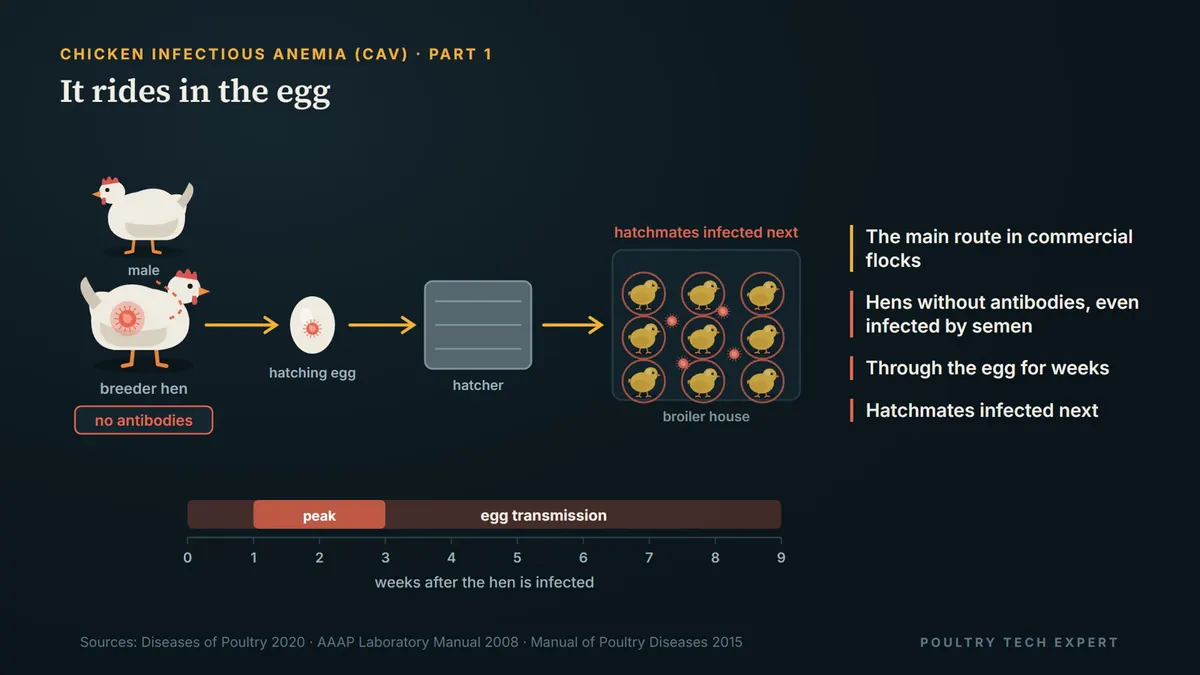
The breeder flock's timing decides whether its broiler chicks hatch infected.
The anemic broiler
Now, the broiler house. Chicks infected through the egg start showing signs at 10 to 12 days of age, with a peak from 17 to 24 days.1 They're pale and depressed, and they stop gaining weight well.2
At necropsy, the most consistent finding is a small thymus. The bone marrow in the thigh bone turns pale and fatty, yellow instead of dark red.5210
Many of the deaths come from secondary problems, like gangrenous dermatitis on the wings or fungal pneumonia.25 Mortality is generally 10 to 20 percent, and it has reached 60.1 How bad it gets depends on how many chicks in the house came from the infected breeder flock, and on what else is going on.2
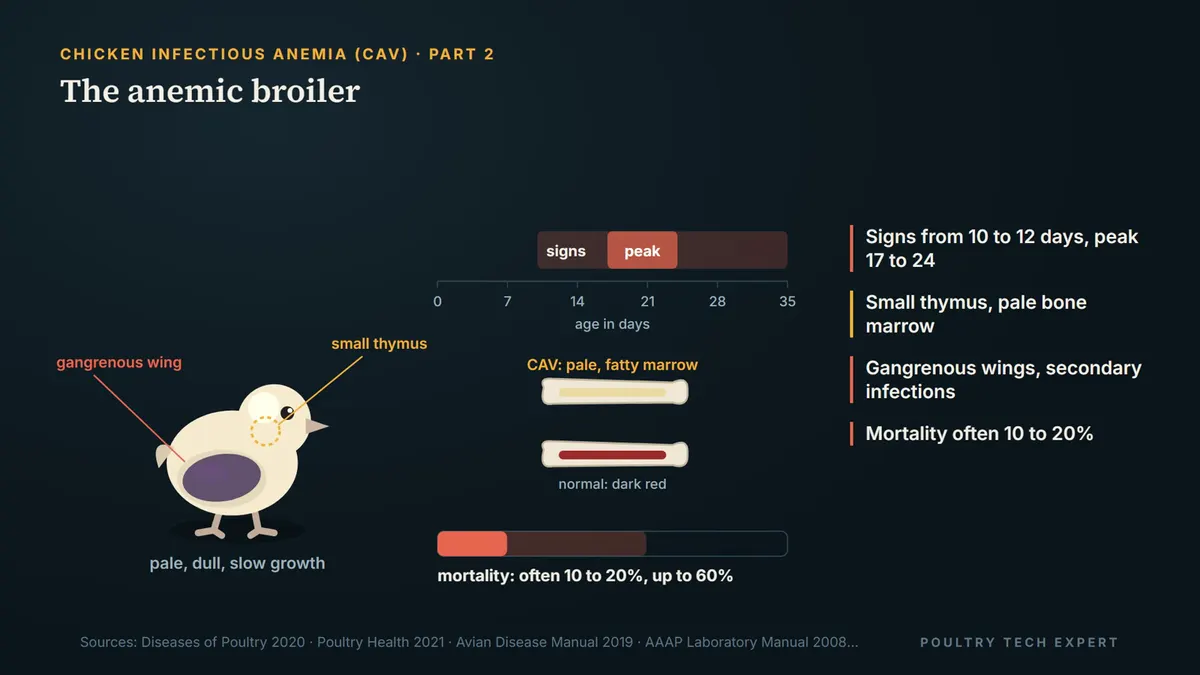
Confirmed CAV at two to four weeks of age points back to the breeder flock.6
What maternal antibodies do
Now, the chicks from immune breeders. Maternal antibodies give young chicks complete protection against the anemia, and that protection lasts about three weeks.1 But they protect against disease, not against infection.4
Chicks also grow out of the anemia with age, and that resistance is complete by about three weeks too.1 That is why the first three weeks are the danger window.
But age doesn't protect against the quiet form. Older birds can still be infected without signs, and the virus still damages the thymus and weakens immunity.1
And other immunosuppressive infections can override both protections. In chicks that also have infectious bursal disease, IBD, maternal antibody and age resistance can be overcome.13
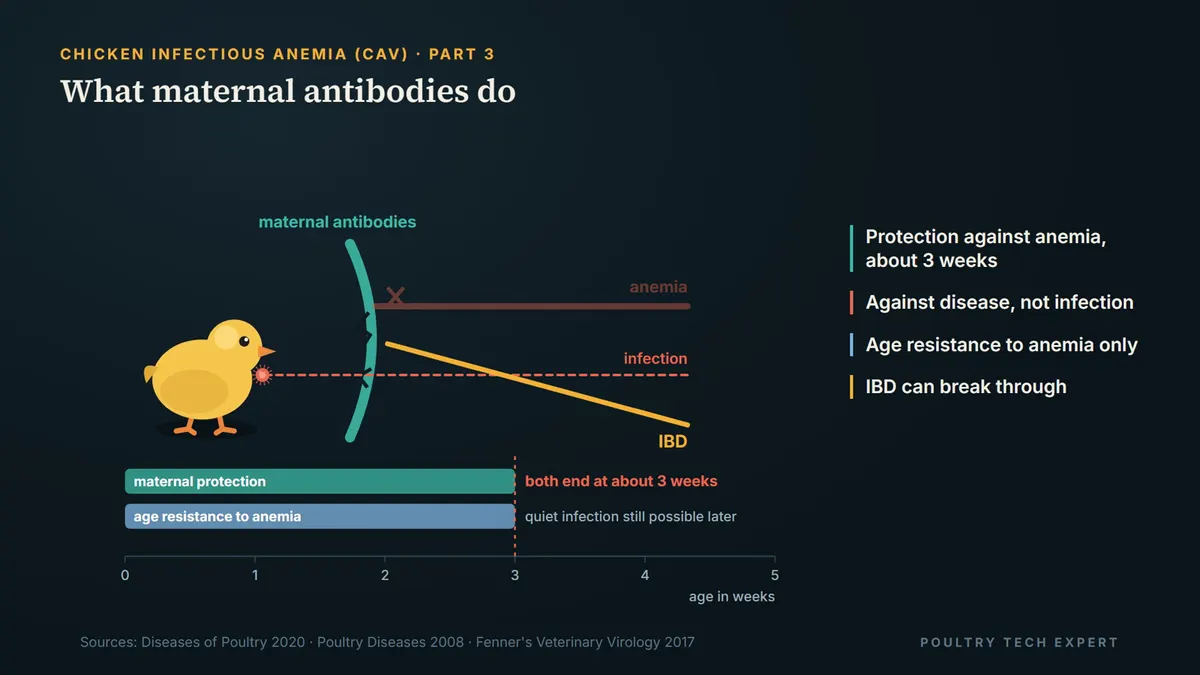
Maternal antibodies stop the anemia, not the virus.
The quiet damage
What happens once that protection is gone? After the maternal antibodies are gone, most infections show no signs at all, and they're common in commercial flocks.1
There's no anemia, but there is immunosuppression. CAV weakens the immune cells that fight Marek's, so the Marek's vaccine works less well, even when CAV arrives as late as two weeks of age.1
It can also make other infections worse, from inclusion body hepatitis to Marek's and IBD themselves.15 In broiler flocks, it's been linked with gangrenous dermatitis, coccidiosis and respiratory disease.1
The field studies on what these quiet infections cost disagree, but experts think the real cost is likely underestimated.1 CAV can make Marek's, IBD and bacterial problems worse, even when no bird looks anemic.
The breeder flock
Now, the breeders themselves. Once their own maternal antibodies are gone, birds that meet the virus get an infection without signs, and no anemia.1 But it still weakens immunity, and that can make the pullets' own vaccines work less well.15
What you need is a flock that's immune before lay. Many flocks get there through natural exposure in rearing, without any signs, and others through the vaccine.31 But natural exposure isn't free, and you can't count on it.
Better hygiene has cut how many flocks turn positive in rearing, and that can cause problems when they meet the virus later in life.1 In one study, 70 percent of grandparent flocks kept in quarantine were still negative at 16 weeks.1
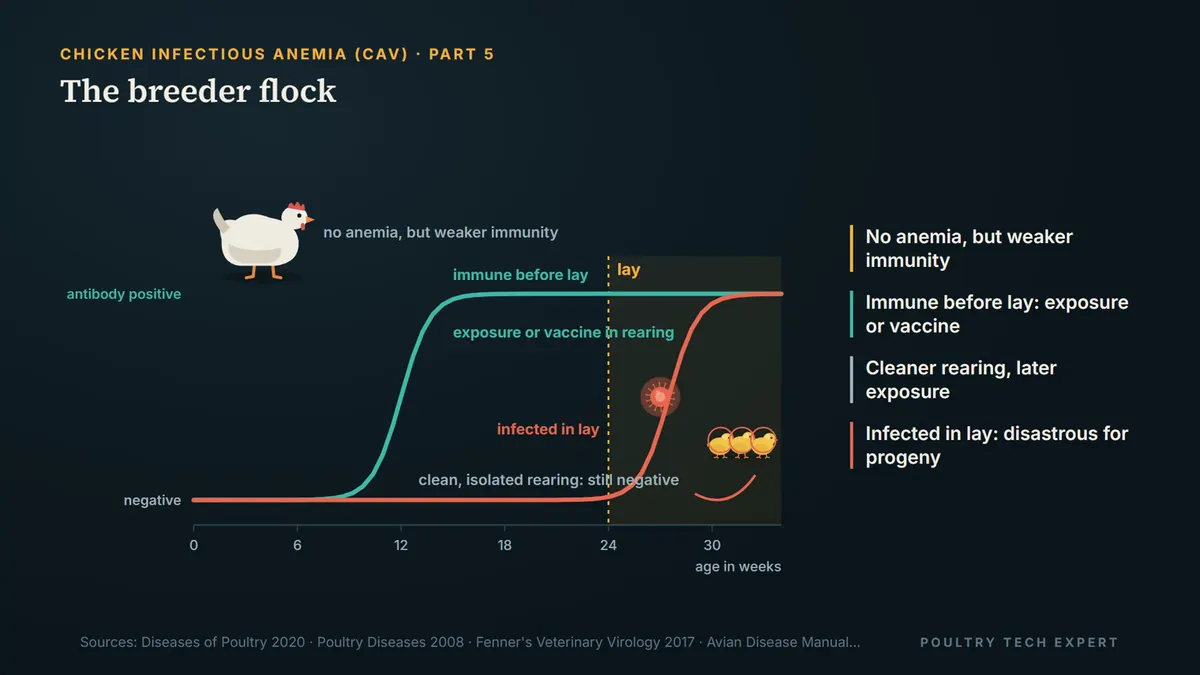
A flock that first meets the virus in lay can have disastrous consequences for its progeny.3 And infecting young breeders on purpose, with litter or tissue from sick birds, is discouraged.14
The cleaner your rearing farm, the less you can assume the flock has met the virus.
Hard to kill
Why not just keep it out? Because CAV is extremely resistant. It survives heating to 80 degrees for 15 minutes.7 Infected birds shed a lot of it in their droppings for five to seven weeks, and it travels in litter, feathers and on equipment.12
In lab tests, the common quat disinfectants didn't work against it. Iodine and chlorine only worked far stronger and longer than normal use, while glutaraldehyde did kill it.1 So ask your vet or supplier for a product tested against CAV.
And formaldehyde fumigation, even for a full day, doesn't kill it completely.1 So fumigation can't be relied on to clear CAV from a house.

Under field conditions, getting rid of it is virtually impossible.13 The cleanout still matters, though. It keeps early exposure down and limits the other infections that make CAV worse.1 And don't carry equipment, or needles used for blood sampling, from one flock to the next, because they can bring it in.2
A cleanout cuts early exposure. It won't make a farm free of CAV.
Test, then vaccinate
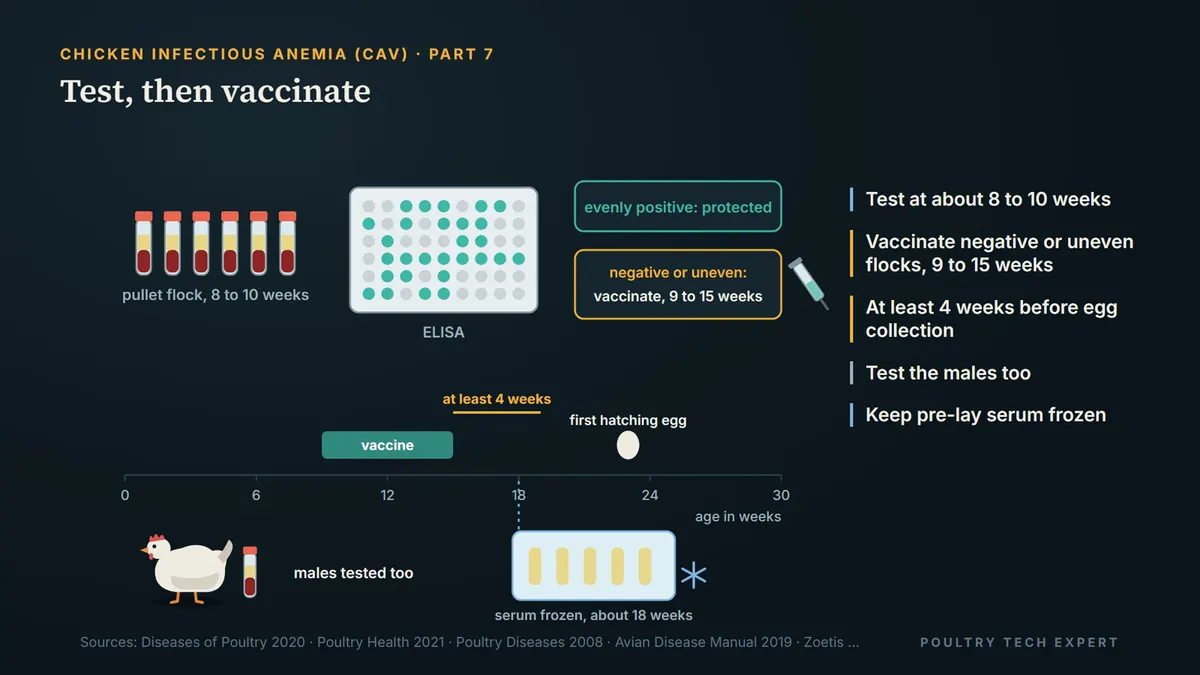
Here's what the breeder side can do. Some companies blood-test breeders at around eight to ten weeks of age to find the flocks that are negative.2 Your vet and the lab decide how many birds to sample and what counts as negative.
Flocks that are negative, or unevenly positive, can then be vaccinated, usually between nine and fifteen weeks of age.1 Other companies simply vaccinate every pullet flock as routine.1 Either way, follow the vaccine label and your vet's program, and test again to confirm the vaccine took.3
Give the live vaccine at least four weeks before you start collecting hatching eggs, because the vaccine virus can also pass through the egg.511 These vaccines are only for birds older than eight weeks, so biosecurity has to cover the flock until then.1
And don't forget the males. Hens can be infected through semen, and males are usually left unvaccinated.1 Include them in the testing, and ask your vet whether to vaccinate them too.
Finally, keep frozen serum from around 18 weeks, usually stored by your vet or the lab. If a problem shows up in the broilers later, it shows whether the breeders turned positive after lay started.2
Know every breeder flock's CAV status before the first hatching egg is collected.
Confirmation belongs to the lab
One check before anything else. Pale chicks and a small thymus suggest CAV, but no single lesion proves it.15
The simplest field check is the packed cell volume, the share of red cells in a blood sample. With CAV anemia it falls below about 27 percent, against about 30 to 35 in healthy birds.5 Inclusion body hepatitis, Marek's, IBD and some toxins can produce parts of the same picture.1
A definitive diagnosis needs the virus found together with thymic atrophy, and the lab can measure how much virus there is, to tell disease from a quiet infection.2
When CAV is confirmed
What if the lab confirms CAV in your broilers? There's no cure. No specific treatment is available for the virus itself, and there's no CAV vaccine for broilers.15
On the broiler farm, your vet decides how to treat the secondary infections, like gangrenous dermatitis.19 Keep IBD under control, because it makes CAV worse, and watch for coccidiosis and gangrenous dermatitis, which often come with it.1
Then tell your hatchery. The hatchery traces which breeder flocks those chicks came from, and the breeder team and the lab compare the stored pre-lay serum with fresh samples. A flock that was negative before lay and is positive now is the likely source.26 Keeping chicks from each breeder flock together, and recorded, makes that tracing much easier.12
It does pass. Once that breeder flock has turned positive, its chicks should again get maternal protection against the anemia.18 Surviving chicks recover over the following weeks, but expect their immunity to stay weaker for a while.1
And on the breeder side, it's back to the testing and vaccination plan.12
In short
CAV in broilers is decided in the breeder house. Every breeder flock needs to be evenly immune, from the virus or the vaccine, well before the first hatching egg.
Know something better, or do it differently on your farms? Tell me in the comments under the video on YouTube.