
Eye drop and wing web are the two methods where every bird passes through someone's hands.
That's their strength. Each bird is handled, so each bird can get a full dose, if the technique is right.67 It's also their cost. Both take a lot of labor, and they need trained people.12
So in modern operations, the eye drop is mostly used for laryngotracheitis vaccine, or ILT,1 although programs can use it for other respiratory vaccines too,7 and the wing web is the classic route for fowl pox.11
The player loads from YouTube (privacy-enhanced mode) only when you press play. Watch it on YouTube.
Why the eye
Just behind the eye sits a gland that's part of the bird's immune system, the Harderian gland.12 A drop on the eye reaches it directly, along with the lining of the airway.7
That gives local protection, with antibody in the tears,8 and antibody in the blood as well.6 And the tears drain through a small duct from the eye into the nose and the mouth, spreading that protection further.8
So one drop on the eye reaches the gland, the airway and the mouth.
Prepare the drops
Make sure the vaccine is approved for eye drop use, and mix it with its own diluent the way the label says, rinsing the vial, so that every bird gets a full label dose.93
The dropper is made for the job. Each drop is very small, about 0.03 mL,12 and the diluent usually carries a dye, so you can see where each drop went.16
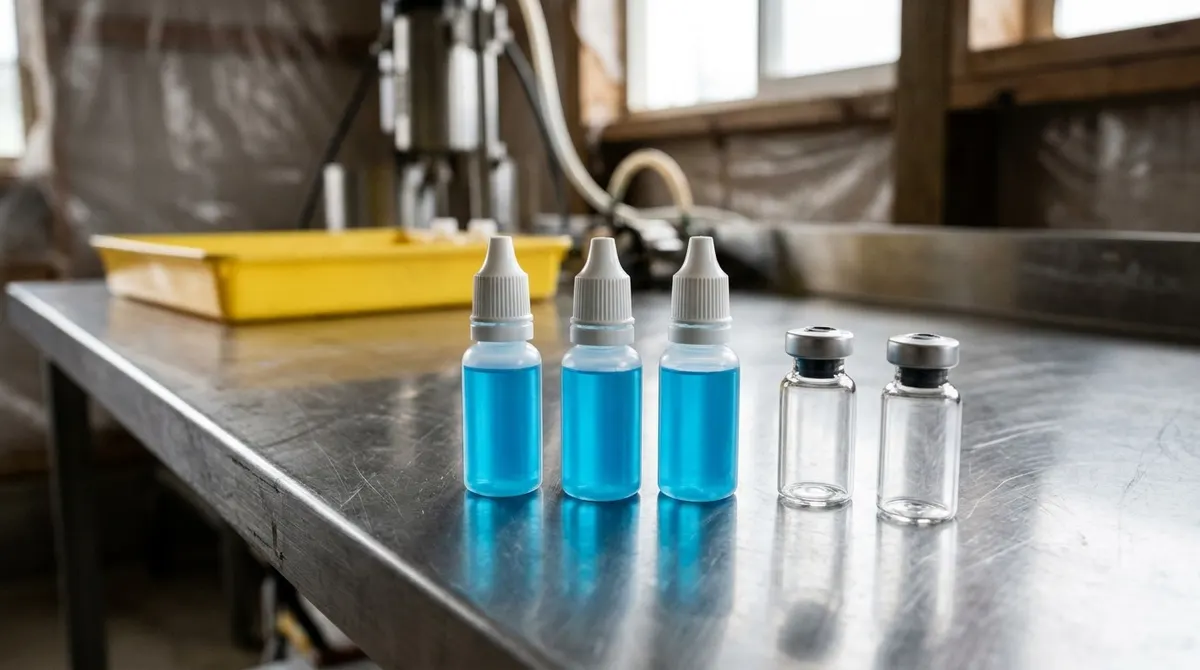
Then watch the temperature. A bottle in a warm hand warms up fast, and the vaccine can lose strength.1 So the guides split it into two or three bottles, and keep the ones not in use in a cooler with ice.45 In hot weather, start early, and never leave bottles in the sun.3
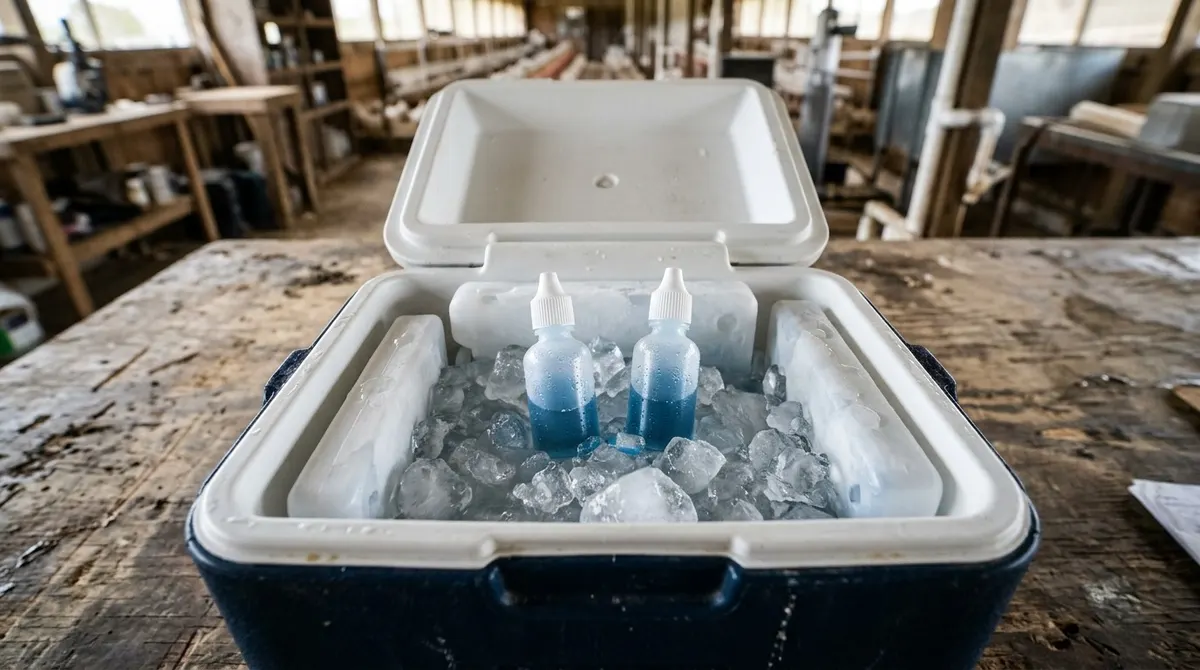
Only the bottle in your hand should be out of the cooler.
The drop
- Set up a small catching pen close to where you vaccinate, on dry litter, with the light turned down where you can, and don't let it get crowded or hot.3
- Catch and hold the birds calmly, with smooth, unhurried movements, and never lift a bird by its neck, a wing or its tail.3
- Hold the bird on its side, with the eye pointing up, so the drop can't roll off,3 and use your free hand to steady the head.4
- Hold the bottle upside down and vertical, so every drop is the same size, and never let the tip touch the eye.34
- Put one drop on the open eye, and wait a few seconds, until the bird blinks and the drop is absorbed.46 If it isn't absorbed, the guides say to give another drop.4
Some vaccines go into the nostril instead: block one nostril with a finger, tilt the head back, and put the drop into the other.3
Don't rush the job,3 and, as one training manual puts it, never put two different eye drop vaccines into the same eye in one session.3 One drop, a blink, then the next bird.
Check the eye drop
The dye shows up around the eye and the nostrils, and often in the mouth, along the edges of the tongue.2 Have a supervisor check birds for dye while the work goes on,4 and if many birds show none, stop and correct the technique.
At the end, compare the number of doses used with the number of birds vaccinated, and write down the vaccine, the batch, and any problems with the birds or the process.45
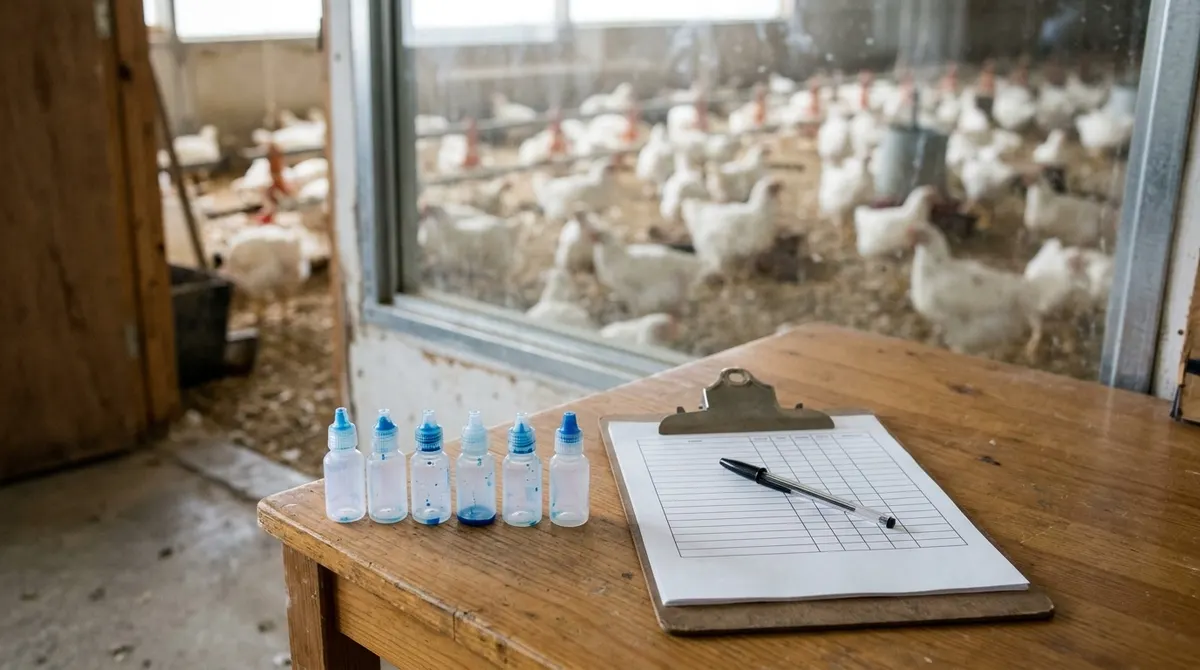
The doses used should match the birds vaccinated.
The wing web
The wing web is the route for fowl pox, and for some vaccines against avian encephalomyelitis, chicken anemia and fowl cholera.45
The tool has two sharp prongs that hold a little vaccine. Dip the prongs into the vaccine before every bird.12 Two prongs cover twice the area, which gives better protection.11 Syringe-type applicators avoid the dipping.1
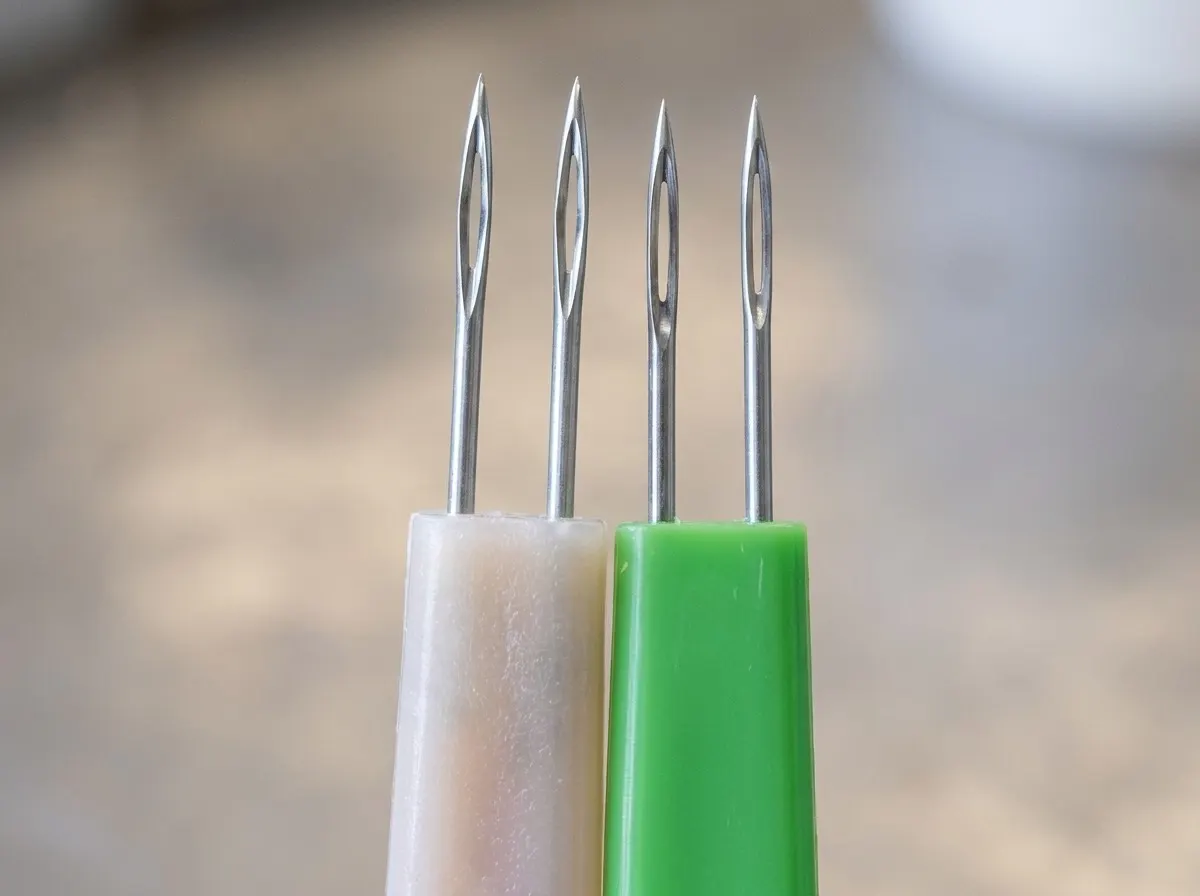
Spread the wing, and push the prongs through the middle of the web from the underside, avoiding the feathers, the blood vessels and the bones.54 If you hit the vein, the guide says to change the applicator needle and vaccinate that bird again.5 One guide also changes the needle every 500 birds.5 And keep the vaccine away from the bird's eyes and mouth.11
A small spot of blue dye in the web, with no blood, is what you want to see.4 The middle of the web, from below, with a fresh dip for every bird.
Check the takes
A week later, check the takes. Seven to ten days after pox vaccination, a successfully vaccinated bird shows a take: a swelling or a scab where the prongs went in.1039 Immunity usually develops over 10 to 14 days.10 So write down the vaccination date, and plan who checks.
Check enough birds. One guide asks for at least 50 per house, and another for at least one bird in ten in large flocks.410 Most birds should show a take.10
If they don't, tell your vet. The usual questions are whether the birds were already immune, whether the vaccine lost strength in the cold chain, or whether it was applied badly.10 Birds vaccinated before often show only weak takes.9
No take, no proof. Look before you trust it.
Keep live vaccine where it belongs
Pox vaccine is a live virus, and it can go where you don't want it. So vaccinate the whole flock on the same day.9
Take the used vials and applicators out of the house, and keep pox vaccine off the beak trimming and other vaccination equipment. Uncontrolled exposure can give pox lesions in birds that were never meant to get it.9
The same care applies to laryngotracheitis vaccine. One layer parent stock guide notes that many outbreaks come from unwanted spread of the vaccine itself,13 so plan the crew's route and hygiene with your vet. Clean up the vaccine kit before you leave the house.
So, in short: cold bottles, one drop and a blink, the middle of the wing web with a fresh dip, and a look at the takes a week later. One drop, one bird, one blink.
Know something better, or do it differently on your farms? Tell me in the comments under the video on YouTube.