
Spray vaccination puts respiratory vaccines into a whole flock at once. Coarse spray against Newcastle disease, infectious bronchitis and coccidiosis is standard in hatcheries, and more and more common in the house.12
The idea is simple. A spray tries to do what an eye drop does, without catching and handling every bird.2
But like water vaccination, it has to reach every bird. When part of the flock is missed, the vaccine keeps circulating from bird to bird, and you get a rolling reaction.9 Getting there comes down to the droplet, the sprayer, the water, the house and the walk.
The player loads from YouTube (privacy-enhanced mode) only when you press play. Watch it on YouTube.
How the spray reaches the bird
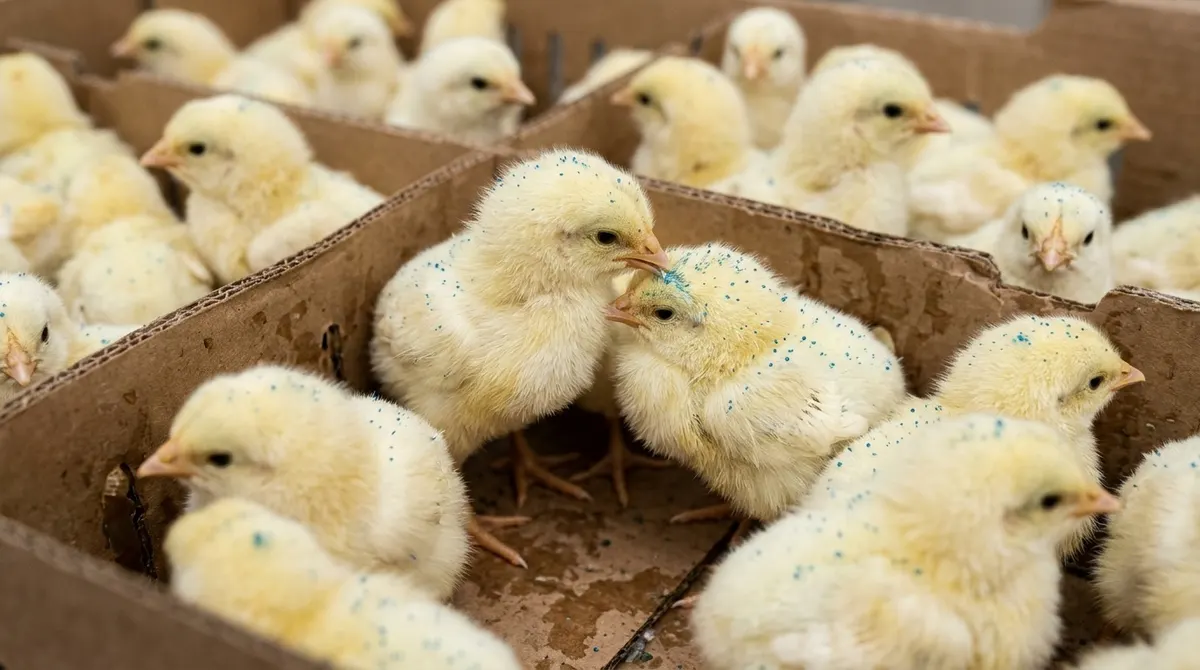
Spray doesn't work only through the air the birds breathe. The droplets land in the eyes, and the birds drink them off each other's feathers.13
In day-old chicks, most sprayers can't even make droplets small enough to be breathed in,13 so the eyes and preening do the work. The droplets on the down catch the other chicks' attention, and they pick them off.14 This preening is thought to be an important part of the response.2
Droplet size
The most important thing in spray vaccination is the size of the droplet.
- Coarse. Guides want a coarse spray, with droplets of about 100 microns or more, which stay in the upper airway, around the eyes, the nose and the beak.4125
- Very fine. Droplets under about 20 microns go deep into the lungs and air sacs, and with respiratory vaccines they can cause strong reactions.126
- Too big. Droplets that are too large fall to the ground, and the vaccine is lost.65
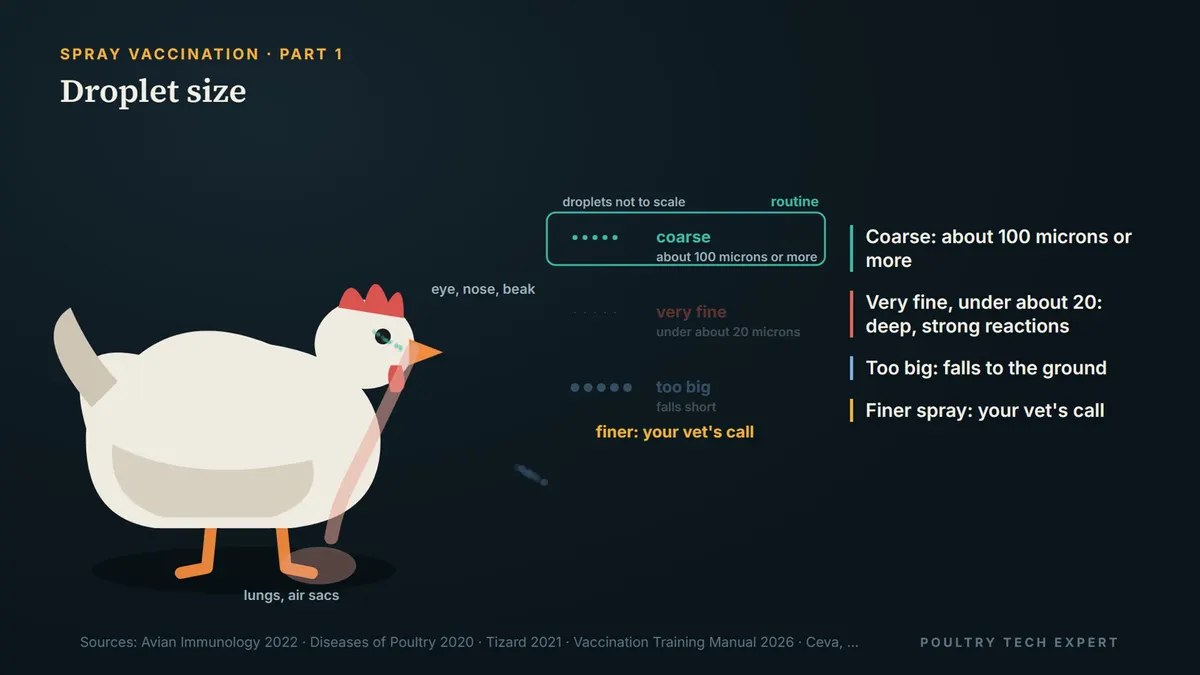
At the hatchery, the cabinet's coarse spray settles evenly over the box, while smaller droplets drift away on the air.12 Afterward, keep the chicks warm, quiet and in good light for a while, so they preen.15 In the house, sprayers usually work at about 100 to 150 microns.12
One vaccine guide reserves true fine spray for boosters in healthy pullets for lay or breeding, and recommends large droplets in flocks carrying mycoplasma.6 So use coarse droplets for routine spraying. Anything finer than a coarse spray is your vet's call.
Check the sprayer first
Check the sprayer before the vaccine day, at least a week before, so there's time for repairs.8
Spray clean water through it and look at the pattern and the droplets. Higher pressure makes smaller droplets, so the pressure has to stay constant, which is why good sprayers have a pressure regulator.746 At the hatchery, a test spray on paper in a chick box shows whether the whole box is covered.1
Then do a dry run in the house with plain water. It shows the volume you need, and it lets the vaccinators practice the walking pace.86
And keep the sprayer for vaccination only. Never put disinfectants, insecticides or other farm chemicals in it.87 The dry run with plain water is where you find the problems, not on the vaccine day.
The water, the mix and the volume
Guides recommend distilled or deionized water. Tap water can carry chlorine, salts and dissolved solids, and they concentrate as the droplets dry, which can harm the vaccine virus.38 Where distilled water isn't available, bottled water without chlorine is a fallback.6
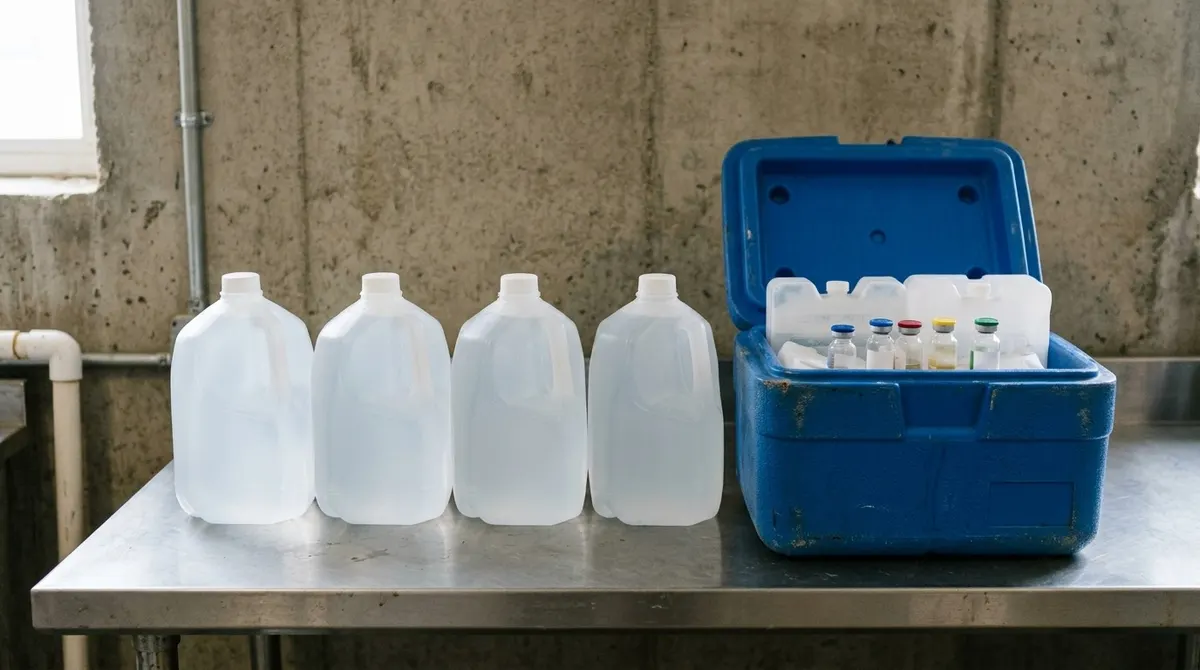
Keep it fresh and cool, but not cold. Warm water can harm the vaccine, and cold water chills young chicks.124
If you use a stabilizer, ask your vaccine supplier which one. Mix it into the water first, then add the vaccine, and mix again. Use it within the time on the label. One field guide says within an hour.11
The volume depends on the age and the sprayer, and guides differ. For older birds with a backpack sprayer, it's about half a liter to a liter per 1,000 birds,36 so 15 to 30 liters for a house of 30,000.8 At the hatchery, the cabinet gives each box a measured amount, which the hatchery team sets with the vaccine supplier.1210
In short: distilled water, cool, stabilizer first, and a volume you tested in the dry run.
Set up the house
Turn the fans off and close the inlets, so the spray isn't blown away before it reaches the birds.329 Spray works better in a closed house than in an open-sided one,3 so in an open-sided house, ask your vet whether spray is the right route.
Dim the lights as low as the vaccinators can still walk safely, and let the birds settle quietly, then start without delay.327
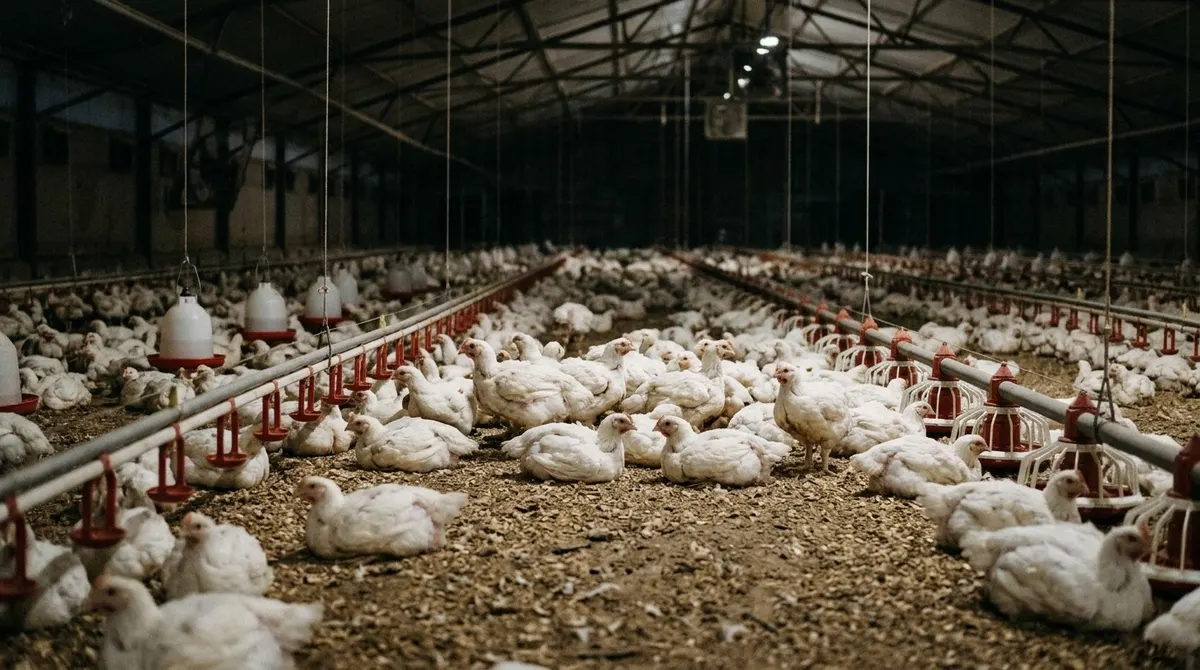
In hot weather, a closed house with the fans off heats up quickly. So vaccinate very early in the morning,78 keep the fans-off time short, and keep someone watching the birds the whole time.8 Calm birds, still air, and the coolest hour of the day.
Walk the spray
Then the spray itself:
- You need at least two people, and everyone wears gloves, a mask and safety glasses while mixing and spraying.7
- One person walks ahead to part the flock, so the birds move apart along the side walls and don't pile up against the back wall.7
- Each vaccinator sprays one side of the house, with the birds no more than about 4 meters away, and in a large house a third goes down the middle.78
- Hold the nozzle about a meter above the birds' heads, angled down.87
- Walk at a steady, even pace, not rushed, and make two complete passes through the house.7
But don't drag the job out. Have the mixing, the refills and the helpers ready before you start, so it runs without stops.
In my experience, the dim light only keeps the birds calm for a while. Their eyes adjust, they start to see, and they get restless. A sudden scare can then send the flock rushing into the walls and corners, where birds pile on top of each other and the ones underneath smother.1617 I've also seen birds die suddenly from the stress. So keep it steady and even, and finish before the birds' eyes adjust.
After the spray
Guides keep the fans low for about 15 to 20 minutes afterward, so the droplets settle on the birds,28 but only if the birds aren't getting heat stressed, and never with the house left unattended.8
Then set the fans and the lights back to where they were, and walk the house to check that the birds have settled back to normal.7
Write down the vaccine, its batch number and expiry, the date and time, the house, and who did it.7 Rinse the sprayer through with distilled water, clean it as its guide says, and store it dry and upside down.78 Dispose of the empty vials properly.7
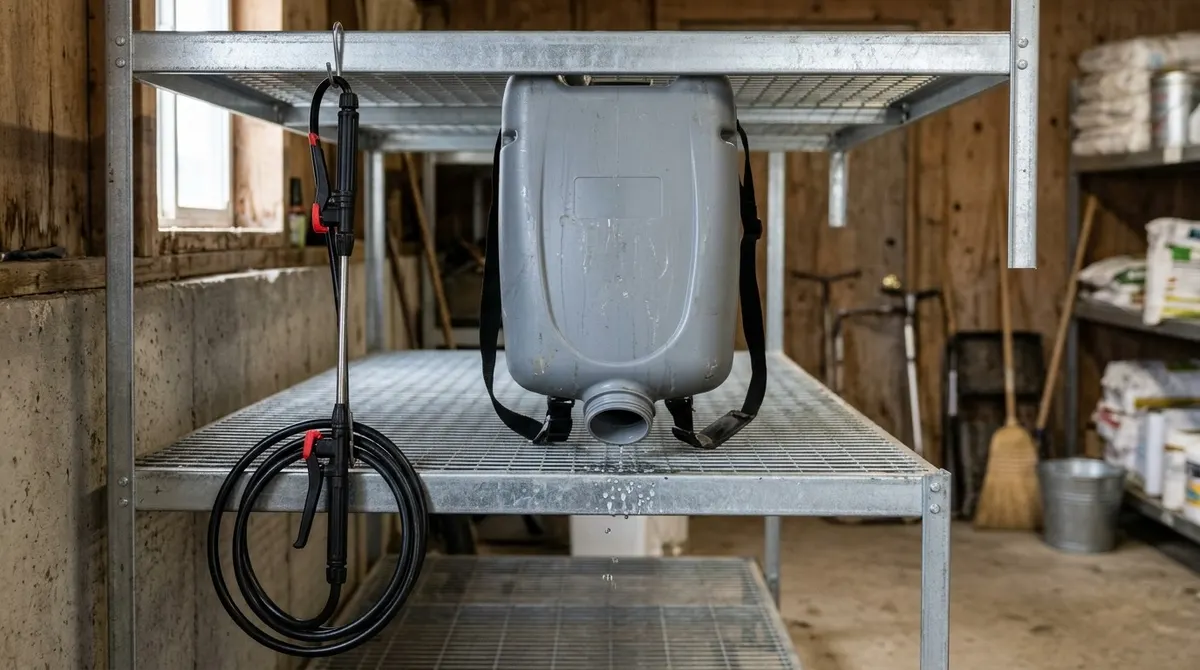
Write it down, clean it out, and the next spray starts right.
So, in short: a coarse spray, a sprayer you checked with plain water, distilled water, still air and dim light, and a steady walk with two passes and no delays. That is how the right droplet reaches every bird.
Know something better, or do it differently on your farms? Tell me in the comments under the video on YouTube.