
Drinking water vaccination looks like the easy one. It's the most common method in the field, and it needs very little equipment.1
But every bird has to drink a full dose, in a short window, from water that hasn't killed the vaccine.21 When only part of the flock gets it, the vaccine keeps circulating, and you get the rolling reactions I described earlier in this series.3
So the work is in the details: clean water, cool water, the right volume, birds that are ready to drink, and lines that deliver vaccine from the first nipple to the last. Here they are in order, from two days before to checking that it worked.
The player loads from YouTube (privacy-enhanced mode) only when you press play. Watch it on YouTube.
Clean water, no sanitizer
Start two days before. Guides call for the chlorinator, any other water sanitizer and any medication in the water to be off about 48 hours before you vaccinate, so plan it with your vet.495 Sanitizer that keeps your water clean on a normal day can inactivate a live vaccine.4
Then get the water system ready:
- Flush the lines with fresh water. The slime that builds up inside the pipes, the biofilm, works against a vaccine given through the water.679
- Bypass or clean the filters, because slime on a filter can hold sanitizer residues.29
- Look at the water itself. It should be close to neutral, and well water with iron or copper may neutralize the vaccine virus.1
- If you mix in a separate tank, use plastic tanks and buckets kept only for vaccination, rinsed but not disinfected.21
On vaccination day, the water system has to be free of anything that kills a vaccine.
Keep it cool
In a hot climate, water temperature matters as much as water quality. Guides ask for cool or cold water,23 and one breeder company sets a clear target for vaccination water: below 20°C.14
Warm water damages the vaccine: heat inactivates the live virus in the water, and bronchitis vaccines are especially heat-sensitive.161713 It also cuts drinking. In one study, drinking and growth dropped from about 27°C.14
The trouble is that a tank or a pipe in the sun heats the water above that, and plastic drinker lines warm up to the air temperature, most of all at the far end of a long line.613
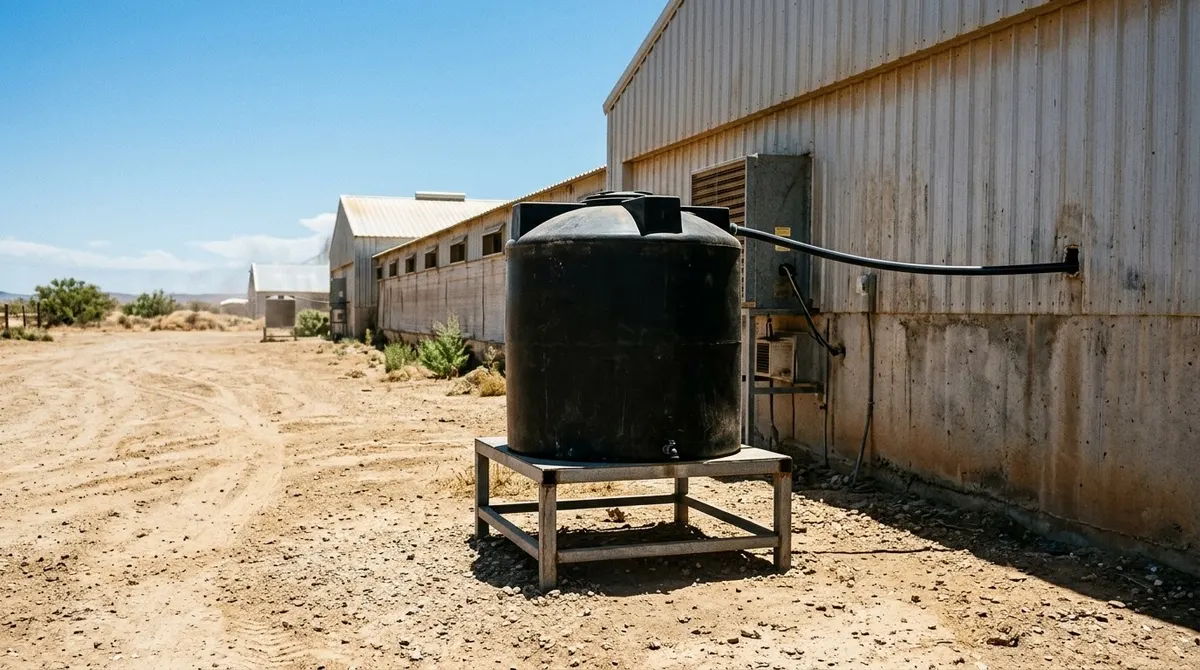
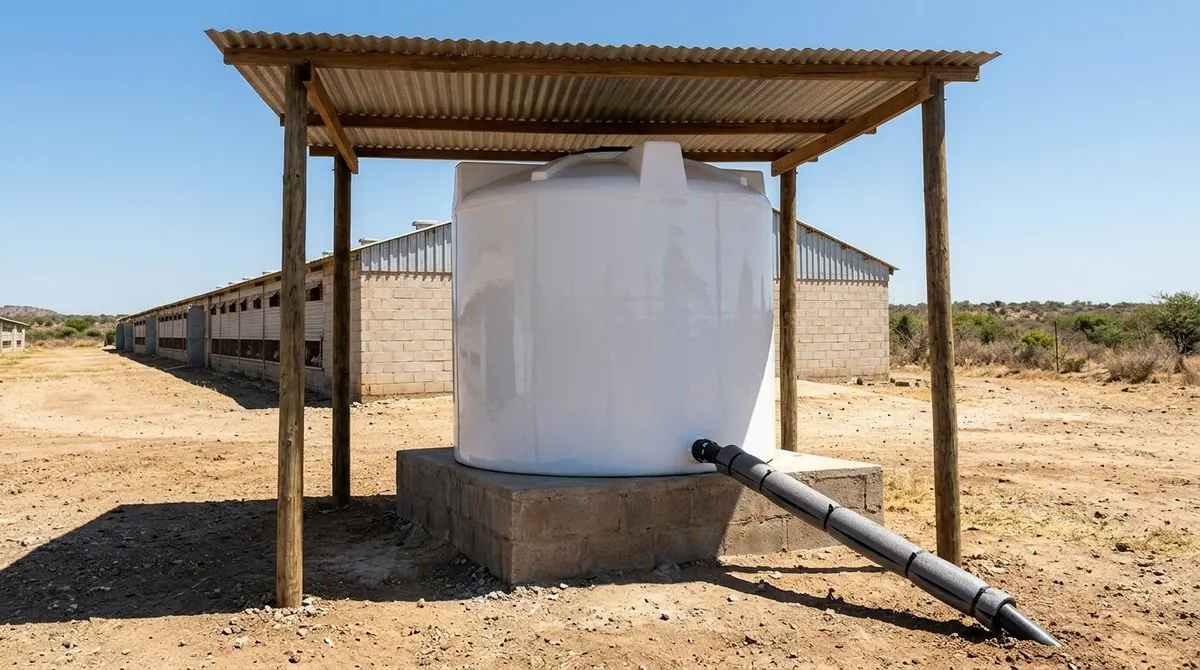
So keep the water cool every day, not just for vaccination. Paint black plastic tanks white,615 or use a reflective paint. Put a roof over the tank, and insulate the tank and the pipes.15614 Where you can, run pipes underground or through your cooling pad water tank.14
For the vaccination itself:
- Check the tank temperature the day before, to plan the ice.
- On vaccination morning, if the water is still too warm, add ice to the tank,146 made from chlorine-free water.1 Count the melted ice in your vaccine volume, and let it all melt before the vaccine goes in, so it mixes evenly.14
- Where the farm has a water cooler, run it for the vaccination.
- Measure the temperature in the tank and at the end of a line before the vaccine goes in,6 and start early, while the house and the water are still cool.19
If you can't get it down, talk to your vet before you vaccinate. In hot weather, measure the water temperature before the vaccine goes in, not after.
The right volume
The best number comes from your own water meter. Read it hourly the day before, and you'll see how much the birds drink and when.2
Aim for the flock to drink the vaccine in about 1.5 to 2 hours.89 Much faster or much slower, and the flock drinks it unevenly.18 Guides put the volume at about a fifth to a third of the daily intake.1947 One also gives a floor: at least 1 liter for each day of age, per 1,000 birds, and more in hot weather.1 For 20,000 birds at three weeks, that's at least 420 liters.
Then add the water already standing in the lines. Some houses hold up to 250 liters, so measure yours.2
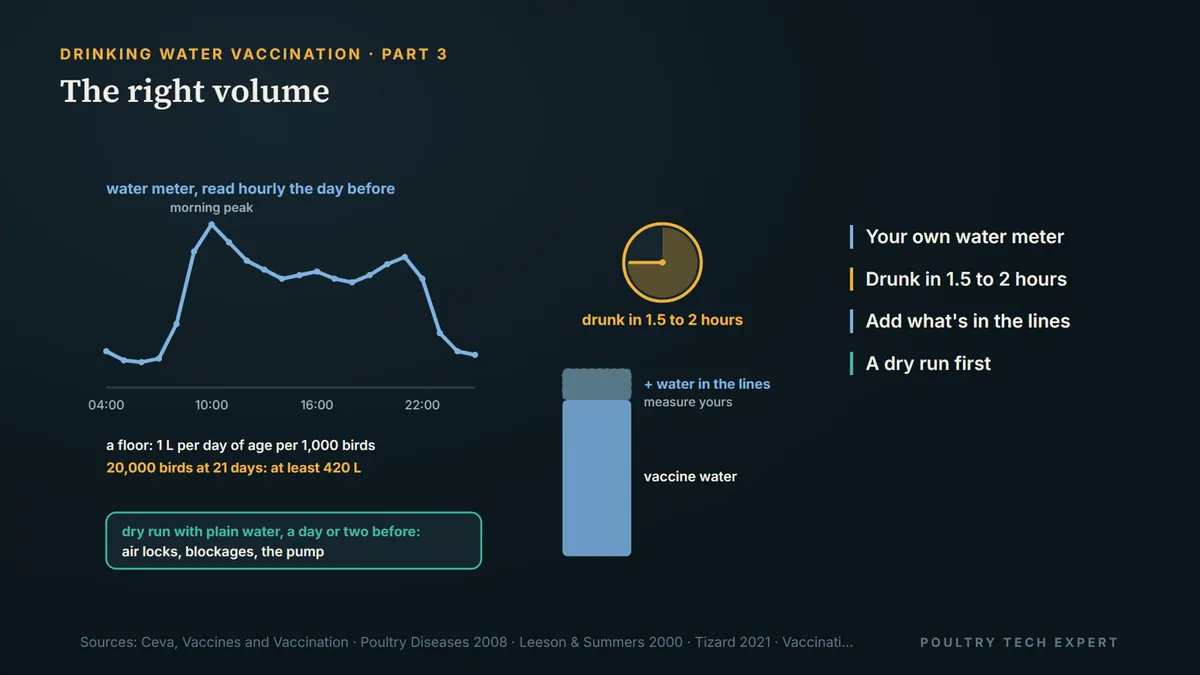
Before a new house or a new age, do a dry run with plain water a day or two ahead. It shows the air locks, the blockages and the pump that won't start.89 Get the volume from your own water meter, not from a table.
Thirst, not dehydration
Take the water away, or raise the lines, for about one to two hours before you vaccinate, so the birds are ready to drink.194 In hot weather, about an hour is usually enough, so the birds don't suffer.14
Don't overdo it. If the birds are really thirsty, they push for the drinkers, the strong birds drink most of the vaccine, and the weaker ones miss out.14
Vaccinate early in the morning, when birds drink actively and it's still cool.19 For breeder pullets on a feed program, do it on the morning of a feed day.9 You want birds interested in water, not desperate for it.
Neutralize first, then the vaccine
In the mixing, the order matters. Skim milk powder at about 2 to 2.5 grams per liter, or a commercial stabilizer, binds chlorine and metal ions that would otherwise damage the vaccine.58110 For 1,000 liters, that's 2 to 2.5 kilos of skim milk. Most guides give it 20 to 30 minutes to work before the vaccine goes in.2910
A stabilizer is a safety margin, not a replacement for turning the sanitizer off. Skim milk only buffers small amounts of chlorine.4
Blue stabilizers also color the water, so you can follow it through the lines and see it on the birds later. Skim milk doesn't, so without a dyed stabilizer, you won't see the blue.21
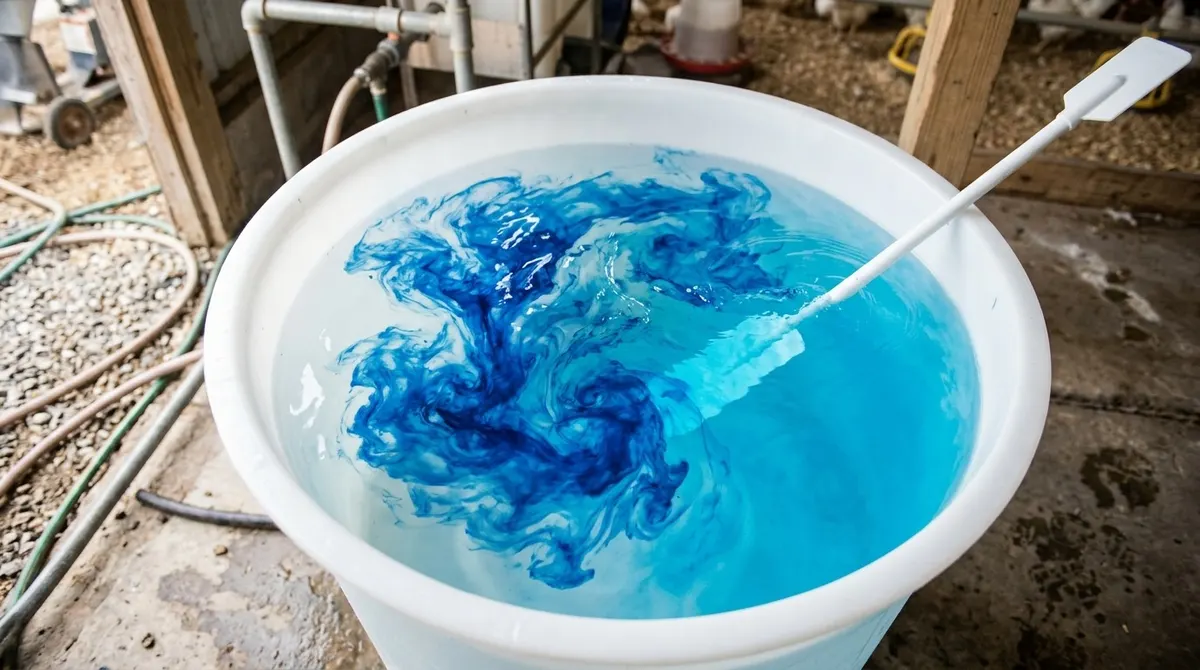
Open the vials under the water, and rinse each vial out.18 Keep the mixed vaccine cool and out of the sun, and use it within two hours.82 If you use a medicator instead of a tank, set it up the way its guide says, and check that it's running.9
Neutralize the water first. The vaccine goes in last.
Prime the lines
This step decides what the far end of the house drinks. With the lines still raised, open the end of each line and run the vaccine water through until the blue appears at the far end. Then close it.98 Without this, the birds at the far end drink the plain water that was standing in the pipe.2
Fill all the lines at the same time, so no part of the house waits longer than another.1 Then lower the lines together, so all the birds start drinking at once, as the lights come up and the feeders run.82
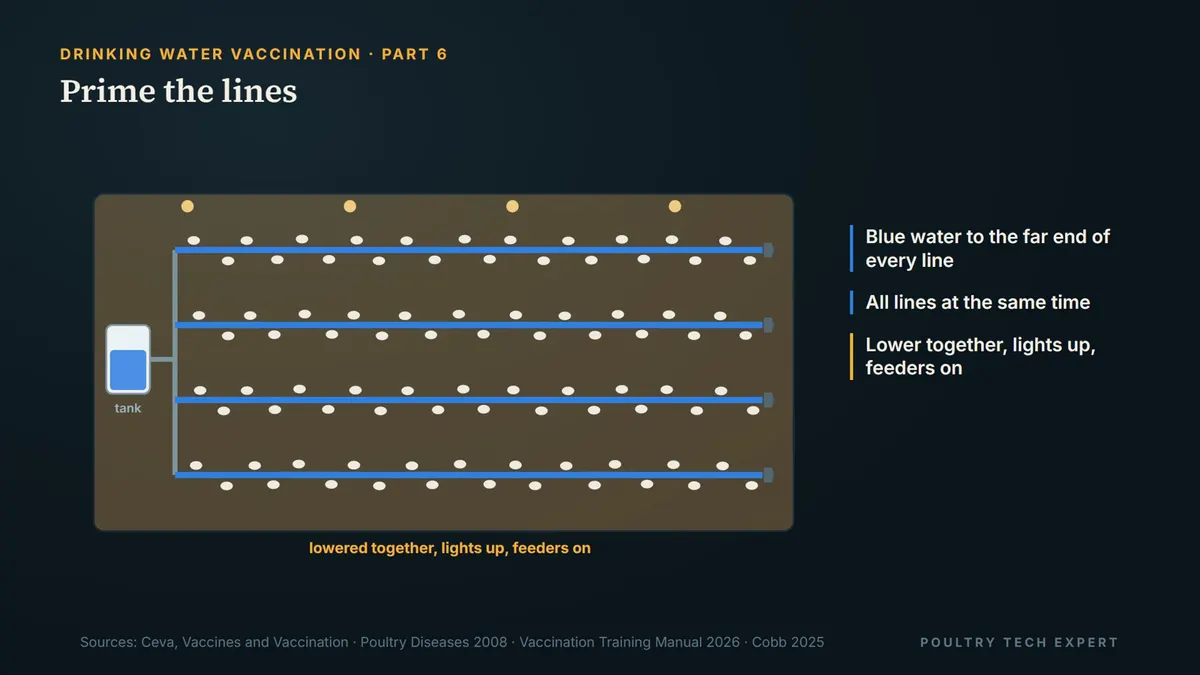
Every nipple should deliver vaccine before the first bird drinks.
Walk the house
While the vaccine is in the lines, walk through the house two or three times, and resting birds get up and drink.981 Use the same rounds to check that vaccine is reaching every line, and that the pump or medicator is still running.19
The birds shouldn't get plain water until the vaccine water is finished. As soon as the vaccine tank is empty, open the main supply again, so the lines never run dry.82
Record how long it took. If it was far from your target, you adjust the volume next time.8 Keep the sanitizer off afterward too, for as long as your program says.195 The drinking time you write down is how next time's volume gets right.
Check that it worked
The dye stains the tongue and the crop of birds that drank, and the color fades within an hour or two.18 So check right when the vaccine water is finished, with birds from all over the house, at least 25 per house.911
Guides aim for 90 to 95 percent of the birds stained.19 With 25 birds, that's at least 23 blue. If you're below that, look at the volume, the thirst, the line ends and the timing, and tell your vet.
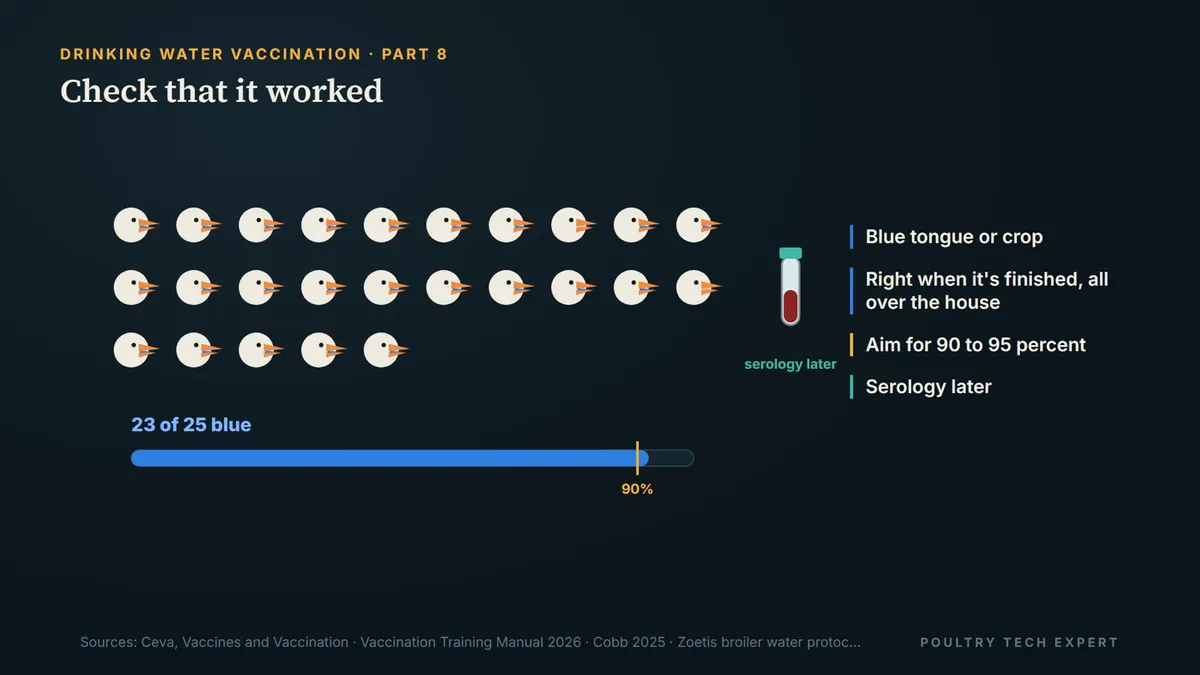
Later, a lab blood test, serology, tells you whether the flock actually responded.812 If fewer than nine in ten birds are blue, too many birds missed the vaccine water.
In short: cool, clean water with no sanitizer, the right volume, and primed lines. Then walk the house, and check for blue tongues. That is how every bird gets one full dose.
Know something better, or do it differently on your farms? Tell me in the comments under the video on YouTube.