
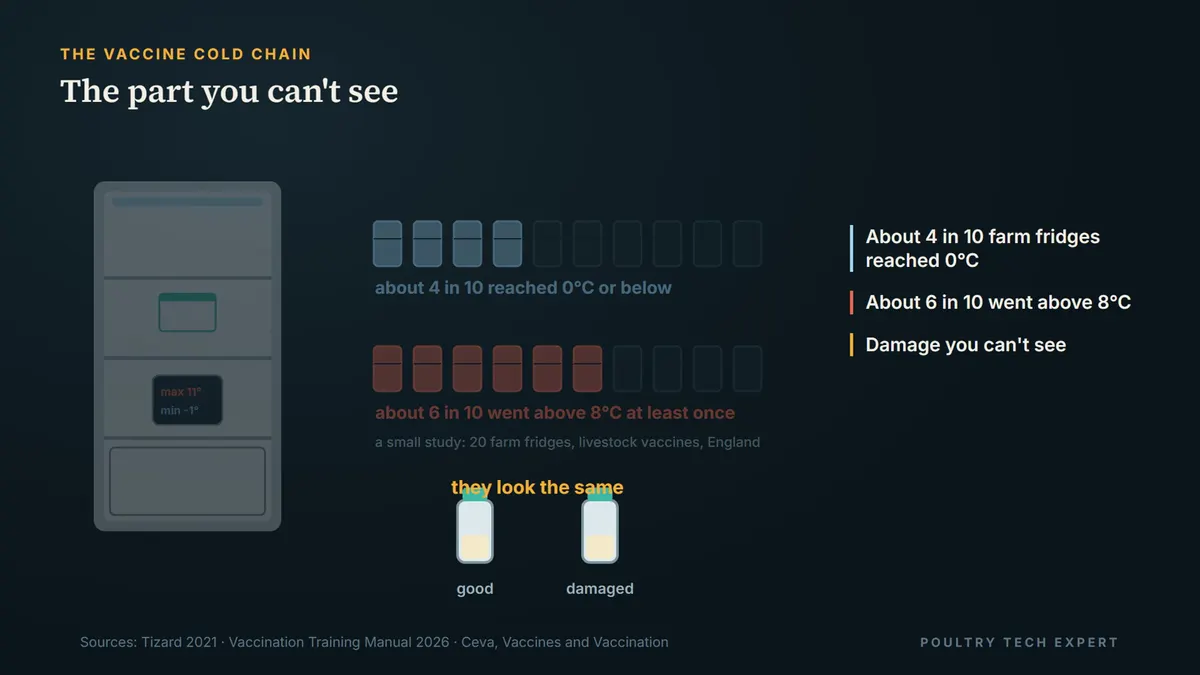
Here's a number that should worry anyone who keeps vaccine on a farm. In a small study of farm fridges in England that held livestock vaccines, about four in ten dropped to 0°C or below.1 And almost six in ten went above 8°C at least once.1 It wasn't a poultry study, but it shows how easily an ordinary farm fridge drifts out of range.
The trouble is that a damaged vaccine usually looks exactly like a good one, especially a freeze-dried one.2 You only find out weeks later, from the flock's performance or the blood tests your vet reads.3
So let's follow a vaccine from the delivery box to the bird, and look at where the cold chain on the farm usually breaks.
The player loads from YouTube (privacy-enhanced mode) only when you press play. Watch it on YouTube.
At the door
The cold chain on your farm starts at the door.
- Vaccines should arrive with cool packs in a well-insulated box. If they arrive warm, call the supplier before you use them.4
- Check that it's the right vaccine, and that it's in the right state. Refrigerated products should be cool, frozen ones fully frozen, and inactivated vaccines must not be frozen.2
- Check how many days it spent in transit, because a parcel held up on the way may have sat in the wrong conditions.2
- Record the number of vials and diluents, the batch numbers and the expiry dates, and get everything into storage straight away.2
The door is the last point where you can still refuse a damaged vaccine.
The vaccine fridge
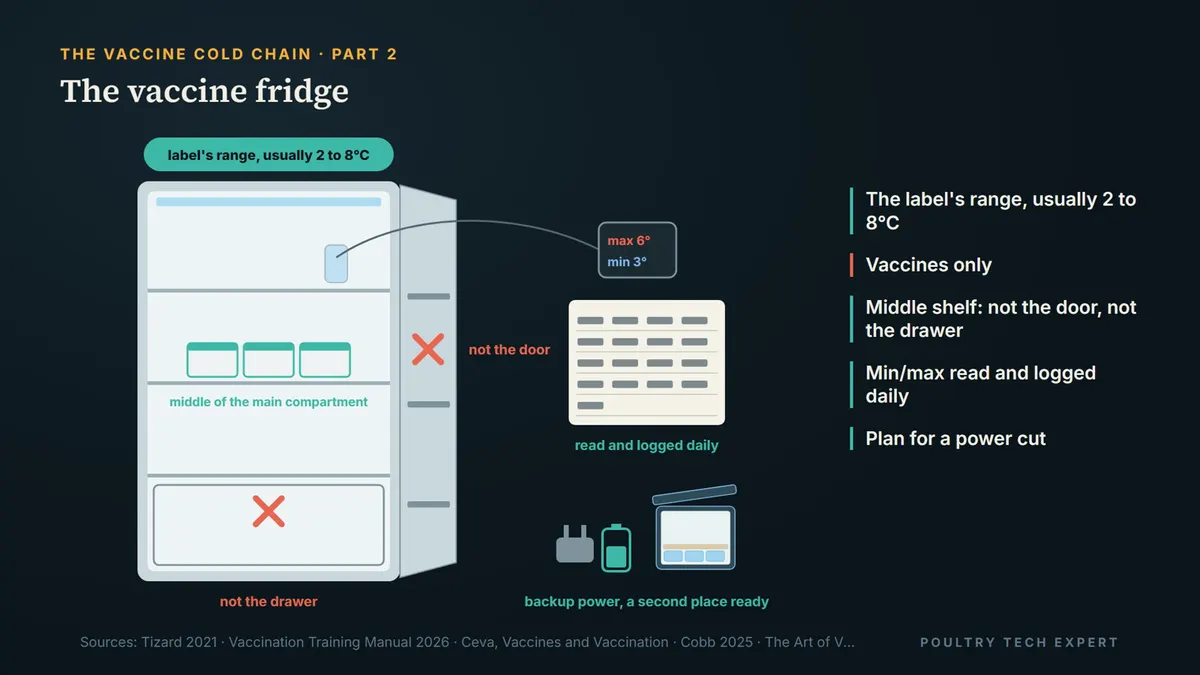
Most vaccines are stored between 2 and 8°C, and some guides set the top lower, at 7°C. Your label gives the exact range.347
Use a fridge for vaccines only, with no food and no general farm use,21 and keep the door closed as much as you can.5
Store the vaccine in the middle of the main compartment. Not in the door, not in the vegetable drawer, and not against the cooling element, the walls or the floor.512
Then measure it properly: a calibrated minimum and maximum thermometer, read and written down every day.56 Put the probe in a small bottle of liquid, because the air temperature can be different from the temperature of the vaccine.6 An alarm on the fridge helps too.2
And plan for a power cut: backup power if you can, and a second fridge or a cool box ready to take the vaccine.61
If nobody wrote down yesterday's minimum and maximum, you don't know what's in that fridge.
Too cold
Now the failure that's easy to miss: too cold.
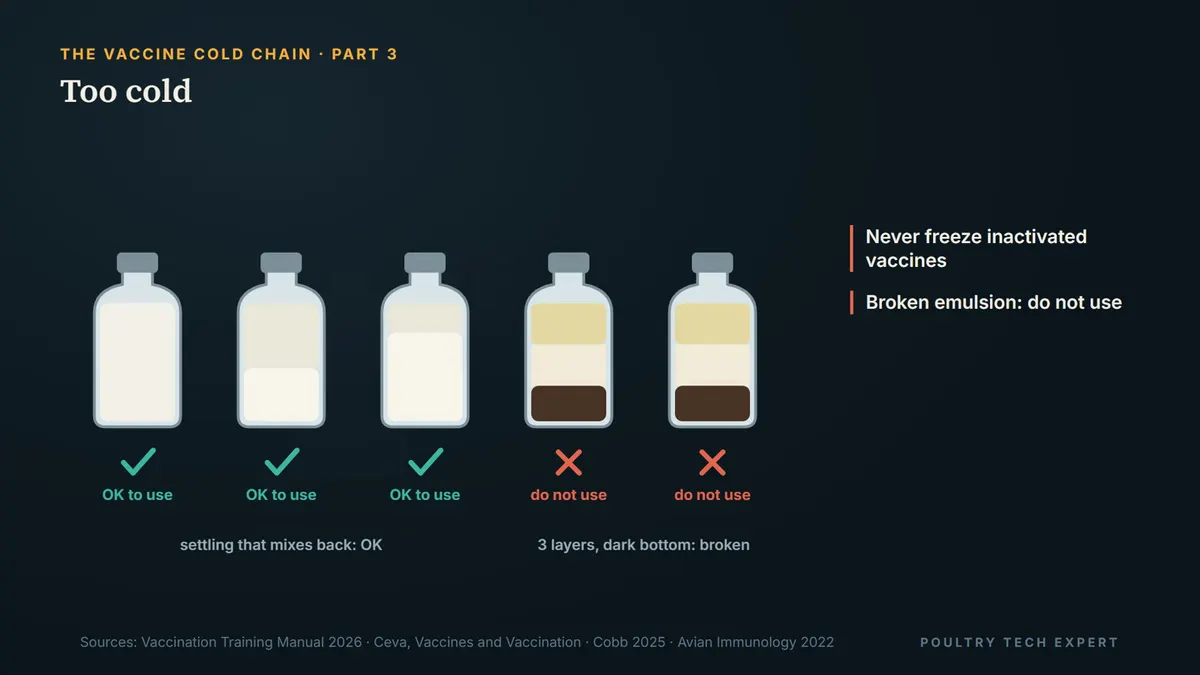
Inactivated vaccines must never be frozen. Freezing destroys the emulsion, the mix of oil and water that carries the vaccine, and makes it ineffective.23
So look at every bottle before you use it. Some settling is normal, and it mixes back.4 But if the layers stay separate after you shake it, and the bottom layer is dark brown or black, the emulsion is broken.4 The test is simple: shake hard for two minutes, let it stand for 15 to 20 minutes, and if it's still separated, don't use it. Call the manufacturer.4
Some live vaccines are supplied frozen, AE and mycoplasma vaccines in some markets, for example. Those go in a chest freezer that doesn't auto-defrost, so they never thaw and refreeze.2 With Marek's vaccines kept in liquid nitrogen, which came up in the article on vector and immune complex vaccines, one thaw and refreeze can cost up to 95 percent of the titer.7
Freezing is just as much a cold chain failure as heat.
On the road
Then the vaccine travels again, from the fridge to the house where you'll use it.2
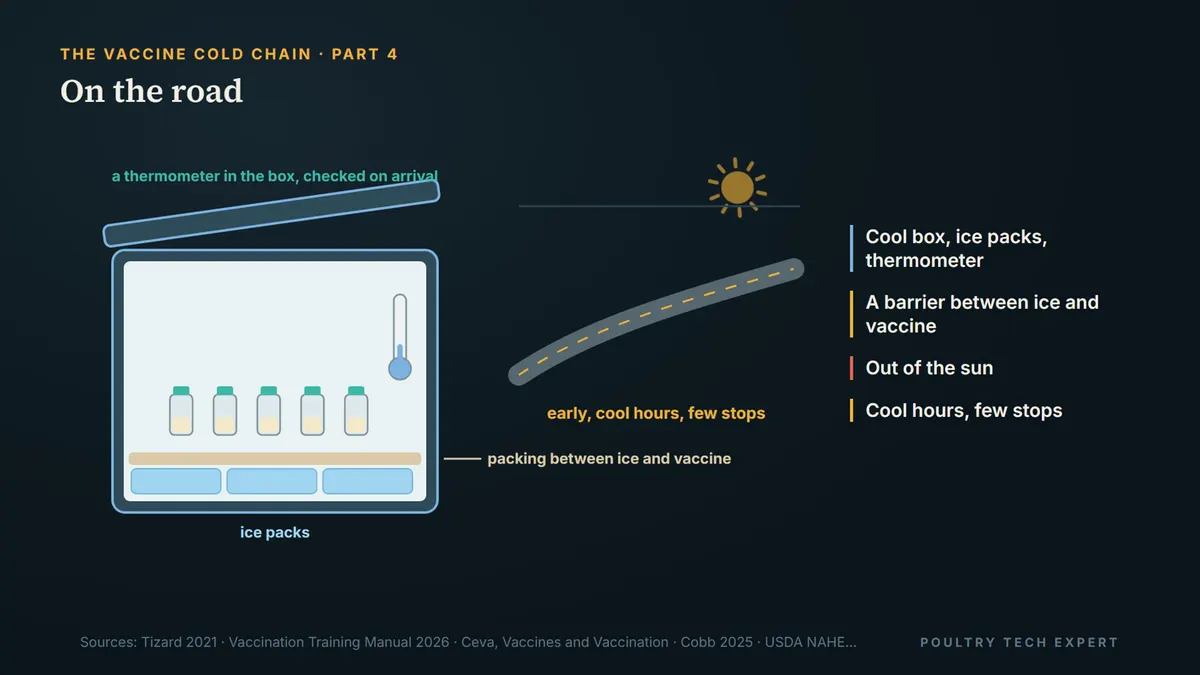
Live vaccines go in a cool box with ice packs, and the box needs a thermometer, because it's hard to see any damage in the vaccine itself.412 A cool pack may not hold the temperature over a full day in a hot climate,1 so check that thermometer when you arrive, not only when you leave.2
Put a layer of packing between the ice packs and the vaccine, so the packs don't freeze it.6 And keep the diluents with their vaccines.6
Keep everything out of direct sunlight. Even a short exposure can lower potency enough to make a vaccine ineffective, and strong sun and heat can destroy even freeze-dried vaccines.21
Where you can, move vaccines in the cool hours of the day, with as few stops as possible.3
Pack for the worst hour of the trip, not the best one.
Mixing starts the clock
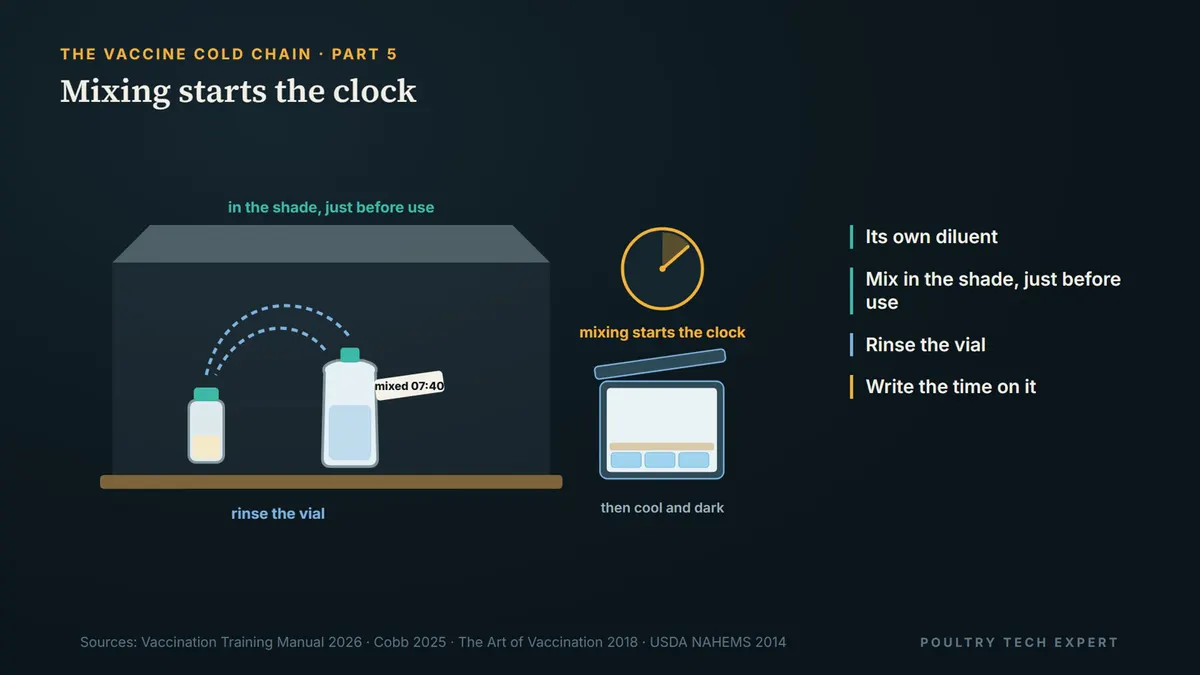
For a live vaccine, mixing starts the clock.
- Always use the diluent, the liquid supplied for that vaccine. Diluents from different vaccines, different manufacturers or even different lots aren't interchangeable.62
- Mix it just before you use it, out of direct sunlight.42
- Rinse the vaccine vial with some of the diluent, so no vaccine stays behind in the glass.2
- From that moment, keep the mixed vaccine cool and out of the light, and use it as soon as you can.2
One breeding company guide allows up to two hours after mixing for Gumboro and Newcastle vaccines, and 45 minutes for Marek's.4 Many labels say less, and the label always wins. Write the mixing time on the container, so nobody has to guess.5
For drinking water vaccination, the water itself matters too, and that has its own article in this series.
Mix only what you can use within the label's time, and write the time on it.
Inactivated: the opposite rule
On breeder and layer farms, inactivated vaccines follow the opposite rule on the last stretch.
They go into the bird at room temperature, which means about 15 to 25°C.2 In a hot climate, a room can be warmer than that, so warm them somewhere that stays in that range.
So take them out of the fridge 12 to 24 hours before you vaccinate. A warm water bath can speed it up, but only the way the manufacturer describes, because too much heat for too long can damage the vaccine.74 Warm vaccine is thinner, easier to inject, and gives fewer severe local reactions.4
Carry them out to the farm in a box without ice, so they reach room temperature.2 And shake them well before and during use.2
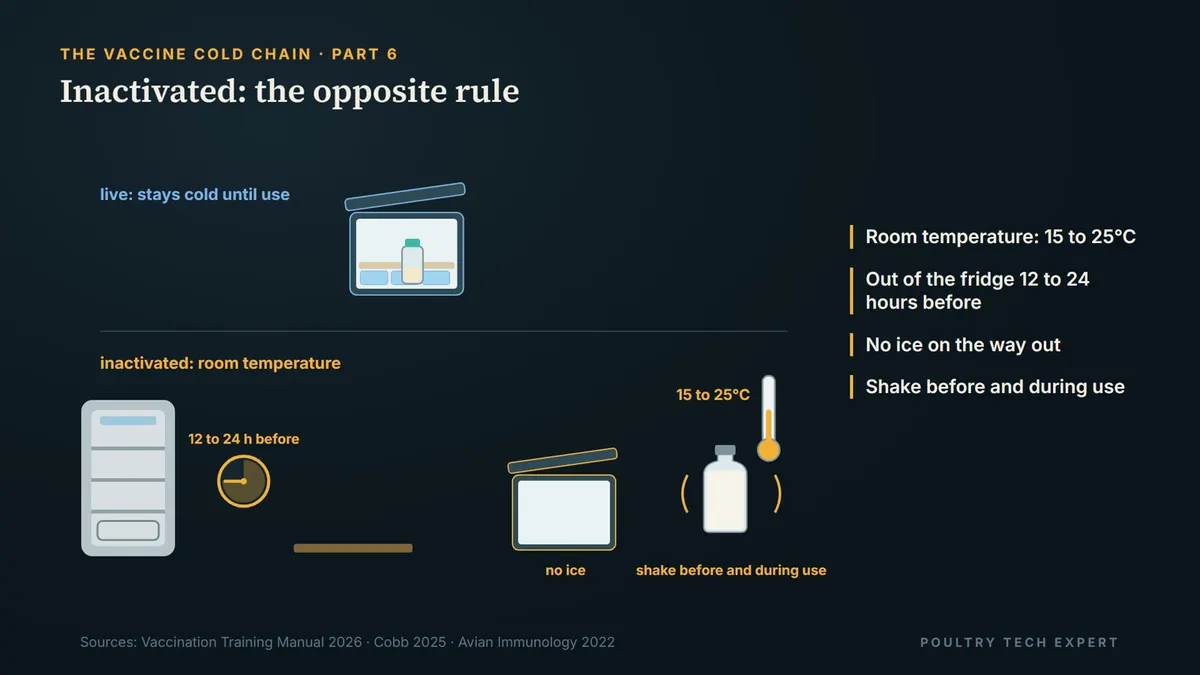
Live vaccines stay cold until the moment they're used. Inactivated vaccines go in at room temperature.
Records and leftovers
The last link is paperwork, and it holds the rest together.
A doubtful bottle costs far less than a flock that isn't protected.2
So, in short: the cold chain runs from the delivery box all the way to the bird. Live vaccines stay cold and in the dark, inactivated vaccines never freeze, and every step gets written down.
Know something better, or do it differently on your farms? Tell me in the comments under the video on YouTube.