
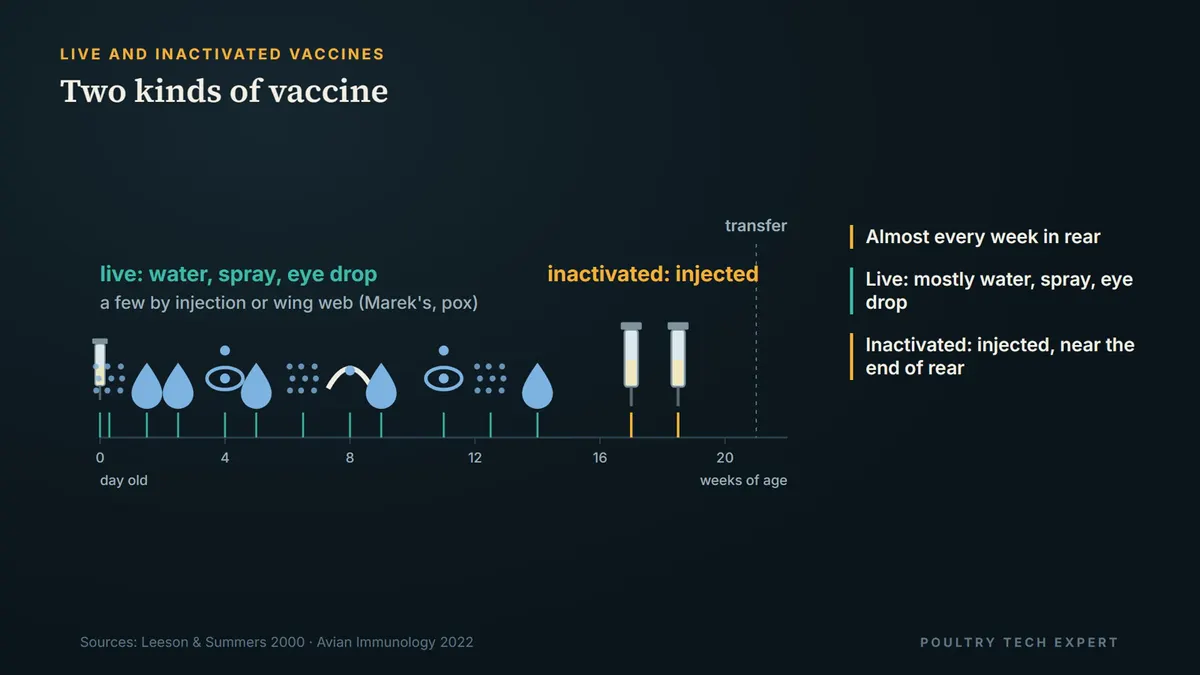
Here's something every breeder manager knows. Between day old and transfer, a breeder pullet may be vaccinated almost every week.1 Most of those are live vaccines, given in the water, by spray or by eye drop, and a few by injection or in the wing web, like Marek's and pox.1 Then, near the end of rear, come the inactivated injections.2
That order isn't tradition. Each type does a different job, and the program only works when you know which job is which.
If you grow broilers, this matters to you too. The breeder's vaccines decide how your chicks start, and I come to that part below.
The player loads from YouTube (privacy-enhanced mode) only when you press play. Watch it on YouTube.
Live vaccines: a controlled infection
A live vaccine is a controlled infection. The virus in it is weakened, so it infects the bird the way the field virus would, usually without the disease, although some vaccines cause mild reactions.36 It multiplies where it lands, then in its target tissue: the trachea for infectious bronchitis, the bursa for infectious bursal disease (IBD).3
Live respiratory vaccines given by spray or eye drop build protection right where the virus gets in, with antibody in the eye, the tears and the airway.2
Live vaccines also activate the immune cells that attack infected cells directly. In Newcastle studies, that response came faster and stronger after live vaccines than after inactivated ones.4
And they're fast. In the field, protection is established within 2 to 8 days, depending on the disease.35 A blood test, on average, only picks up the antibodies after 10 to 15 days.3
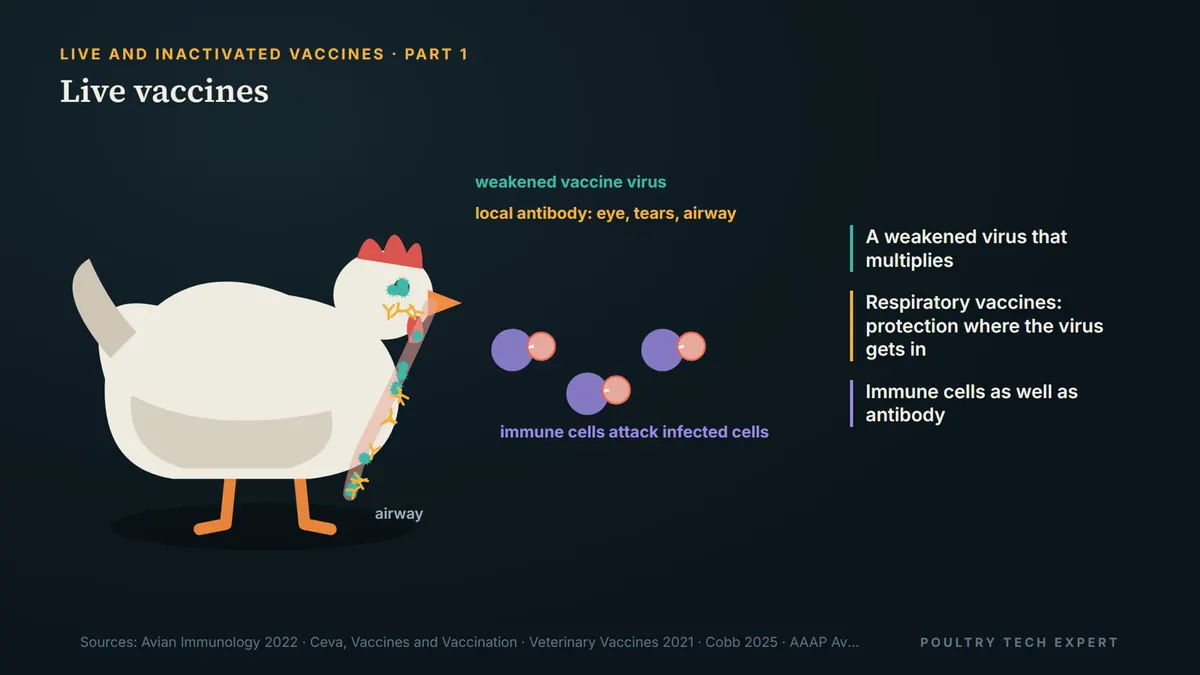
A live respiratory vaccine defends the door the field virus will use.
The limits of live
Most conventional live vaccines have limits, and you manage many of them on the farm.
- Protection fades. From most live vaccines it typically lasts about 4 to 10 weeks, so programs include boosters.3 Marek's and IBD vaccines are the exceptions that last much longer.2
- Maternal antibodies interfere. They can neutralize a live vaccine, which matters most for IBD. That's why your vet times those vaccinations, often from chick blood tests.610
- The vaccine virus spreads from bird to bird. That can reach a bird you missed, but uneven exposure brings unexpected or longer reactions.6 When only part of the flock takes the vaccine, it keeps circulating, and that's the rolling reaction you see after a poor bronchitis vaccination.7
- It's a living product. Careless handling can kill it before it reaches a single bird.6
Many programs now also use hatchery vaccines, vector and immune complex vaccines, which can work despite maternal antibodies.1012 They deserve an article of their own.
With live vaccines, the goal is every bird, a full dose, at the same time.8
Inactivated vaccines
Inactivated vaccines work the other way around. The virus or bacteria are killed and usually mixed in oil.62 They can't multiply in the bird, so every bird has to be injected.1
The oil releases the antigen slowly, and in birds primed with live vaccines, that gives long protection.61 It's in place after about 2 to 3 weeks, and it lasts for months.3
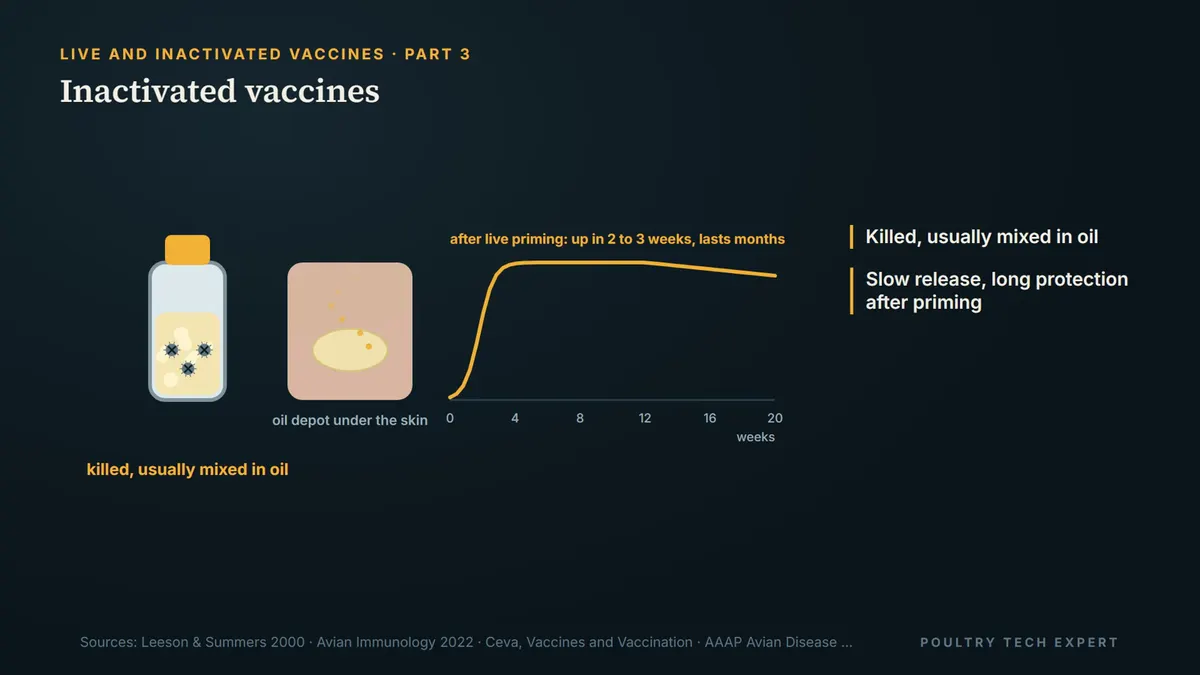
What you get is mainly antibody in the blood.3 In infectious bronchitis, for example, inactivated vaccines in primed birds give high blood antibody and protect the kidney and the egg-producing tract.7 But they're much weaker at stopping infection of the airway.7
On the plus side, they can't spread and can't become dangerous again, and they're less fragile than live products, though they still belong in the fridge, never frozen.62 The flip side is simple: a missed bird stays unvaccinated.6
An injection protects one bird only: the one that got the full dose.
Prime, then boost
So how do the two fit together? A broiler lives 5 to 8 weeks, so a short program is usually enough.2 A breeder lives up to two years, and apart from Marek's and IBD, live vaccines given early in life are unlikely to last that long.2
The first time a bird meets an antigen, the response is slow, and it's short.9 A later exposure usually gives a faster and longer response, because the immune memory is already there.9 That's priming and boosting.
In a breeder program, the live vaccines in rear do the priming, and the inactivated vaccine at the end of rear is the boost.2 An inactivated bronchitis vaccine depends heavily on that priming.7 So when the titers after the injection come back low or uneven, weak priming can be the cause, as well as missed birds or a poor injection. Your vet will check the priming as well as the injection.9
Timing matters too. For infectious bronchitis, programs typically leave at least 4 weeks between the last live vaccine and the injection, ideally 6, and give the injection about a month before lay, so the response is fully developed when production starts.9 Some inactivated vaccines, like egg drop syndrome, don't depend on live priming at all.2
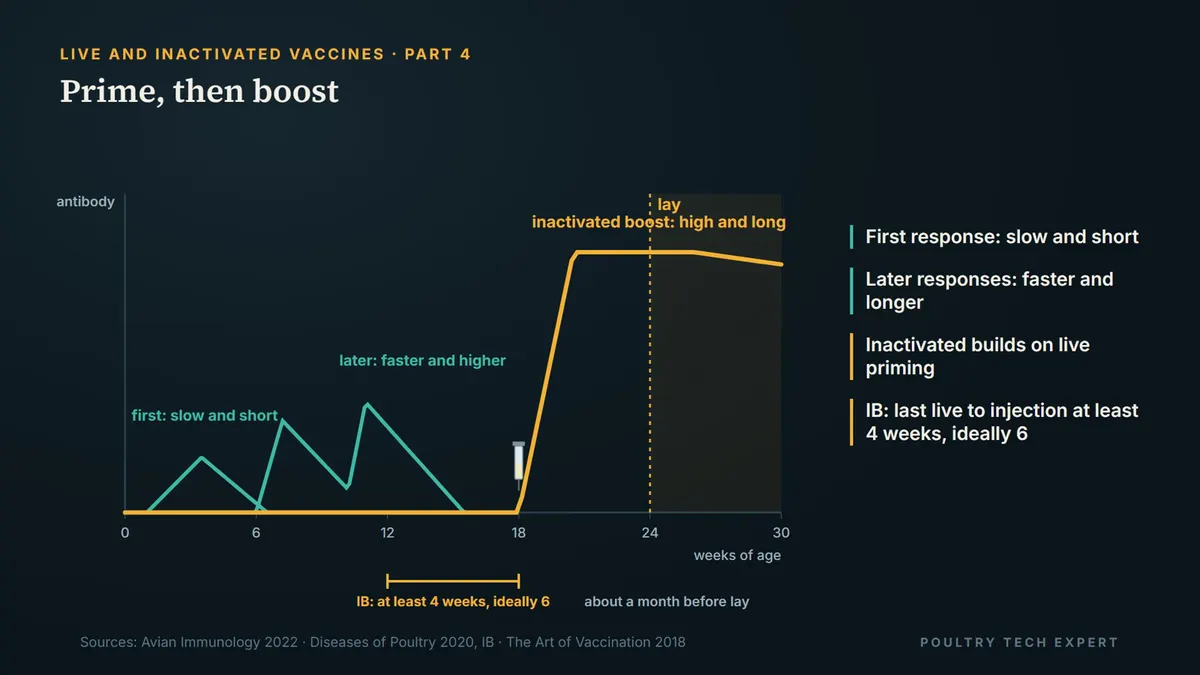
The injection can only boost what the live program has built.
What the hen passes on
In breeders, that injection has a second customer: the chick.2
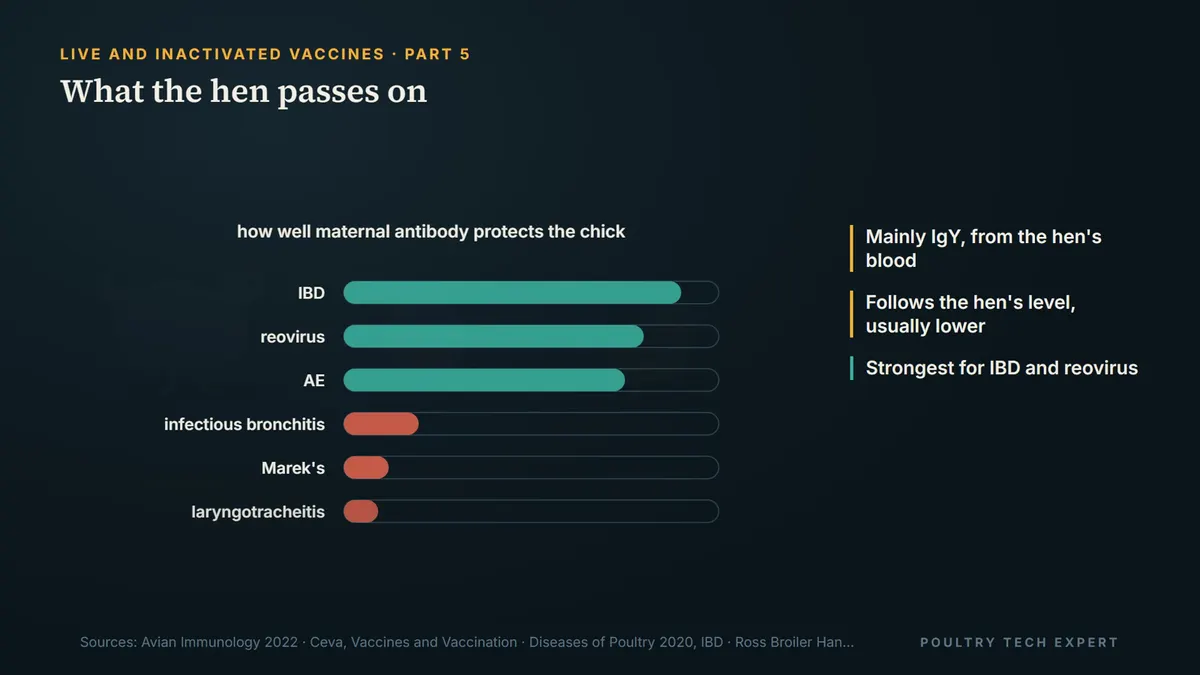
Mainly antibody from the hen's blood, called IgY, goes into the yolk, and how much depends on her own level.2 So the chick's maternal antibody follows the hen's titer, usually at a lower level.3 Her immune cells don't pass on at all.3
Maternal antibody protects the chick best against IBD, reovirus and avian encephalomyelitis, and much less against infectious bronchitis, Marek's or laryngotracheitis.32 With IBD, it normally protects for 1 to 3 weeks, and boosting the breeders with oil vaccines can stretch that to 4 or 5 weeks.10
And the level falls as the breeder flock gets older, so chicks from old flocks start with less.11 That's why broiler managers should know which breeder flocks their chicks come from, and talk about it with the hatchery and the vet.
The breeder's titers when the egg is laid become the chick's first protection, strongest against IBD.
On the farm
On the farm, all of this comes down to a few habits.
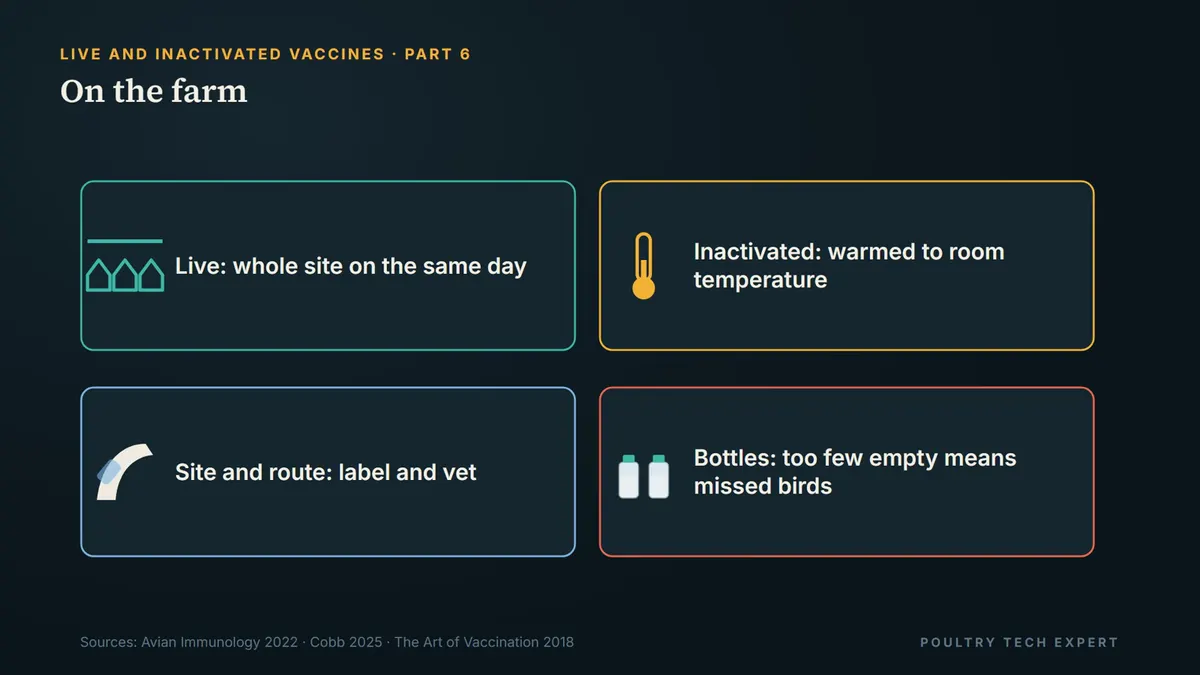
A matching bottle count is the minimum, not proof that every bird got its dose.
Reading the result
A blood titer measures antibody in the blood. It's used because there's no simple routine test for the rest.2 Protection in the airway and from the immune cells doesn't show up in it.38
So the antibody level doesn't always reflect protection.3 Chicks given live respiratory vaccines at day old, with maternal antibody on board, can show no antibody in the blood test and still be well protected.2 And a high titer after an injection doesn't mean the airway is covered.7
So, in short: live vaccines are fast and work where the virus gets in, but most of them fade. Inactivated vaccines last, but only in the bird you injected, and for most diseases only as well as the priming before them. Live primes, inactivated boosts.
Know something better, or do it differently on your farms? Tell me in the comments under the video on YouTube.