
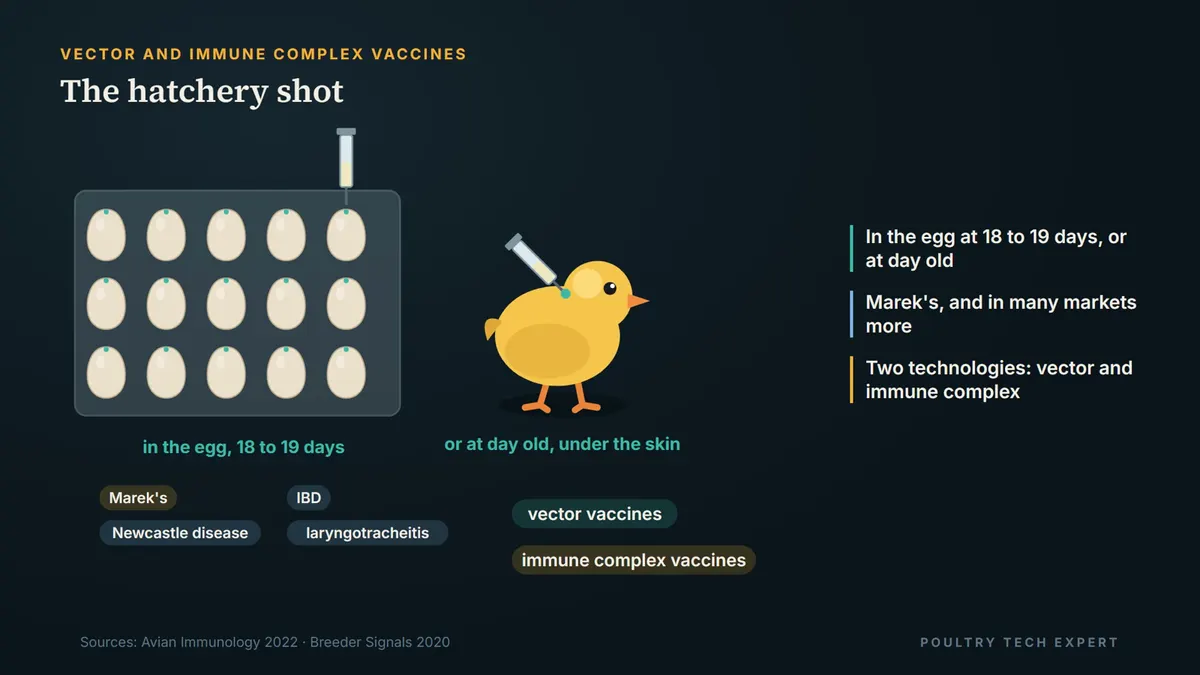
In many markets, broiler chicks arrive on the farm already vaccinated against more than one disease, and you can't see it on the birds. It was done in the egg at about 18 days of incubation, or by injection at day old.1
For a long time, that hatchery shot was mainly about Marek's disease. Now it can also carry protection against IBD, Newcastle disease or laryngotracheitis.1
Two technologies make that possible: vector vaccines and immune complex vaccines.12 Both are hatchery vaccines that work even while the chick still carries its mother's antibodies. In the earlier article on live and inactivated vaccines, I said they deserve their own article, so here it is.
The player loads from YouTube (privacy-enhanced mode) only when you press play. Watch it on YouTube.
What a vector vaccine is
A vector vaccine is a carrier with a passenger.
The carrier, the vector, is a live virus that doesn't cause disease, often one that's already used as a vaccine.13 Into the carrier, the makers add one or two genes from the disease. They're the genes for the part of that disease the bird's immune system learns to recognize.131
After the injection, the carrier infects the bird's cells, and those cells start making that one protein. The bird answers it, with antibody and with immune cells.132 For IBD, the gene is for VP2, the main protein on the outside of the virus and the main target of protection.4
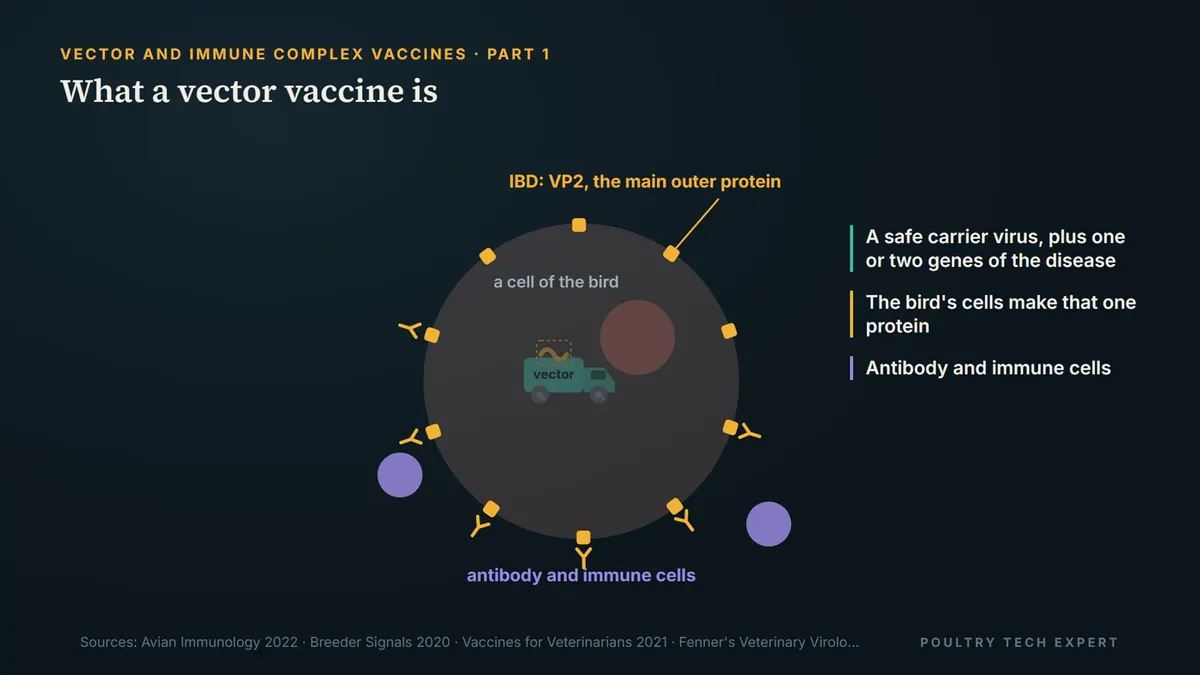
The bird learns to recognize one piece of the disease, without ever meeting the disease.
The common vectors
In poultry, two carriers do most of the work.1
The first is HVT, the turkey herpesvirus that's been used for years as a Marek's vaccine, so an HVT vector also helps protect against Marek's.167 It's injected in the egg or at day old, and HVT vectors are used worldwide. They carry a gene from IBD, Newcastle disease, laryngotracheitis or avian influenza, and some newer ones carry two, for IBD and Newcastle disease together.1
The second is fowlpox virus. Fowlpox vectors carry genes from Newcastle disease, laryngotracheitis, avian influenza or mycoplasma,1 and the Newcastle fowlpox vaccine, for example, goes under the skin at day old or by wing web.15
Newcastle disease virus itself can also be a carrier, for example for avian influenza or IBD.4
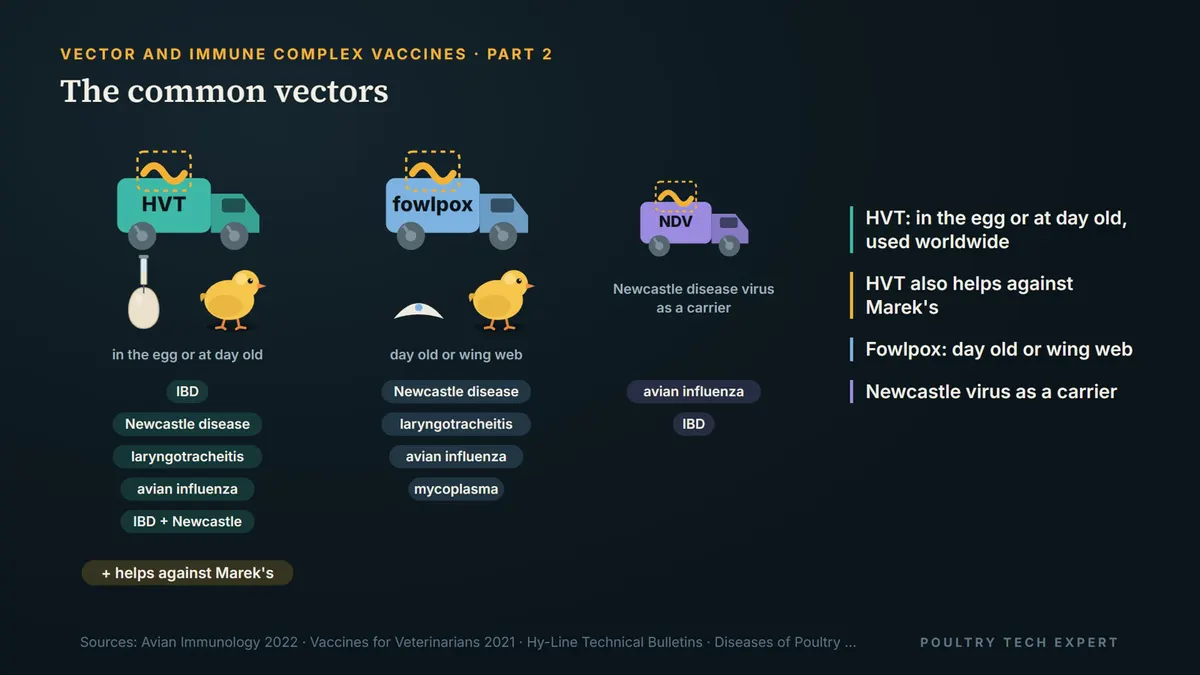
Most hatchery vectors you'll meet are HVT, and they help against Marek's too.
Live, vector or inactivated
So how is a vector different from the live and inactivated vaccines from part one?
Like a conventional live vaccine, it's alive and multiplies in the bird,2 and it can build immune cells as well as antibody.13
But a conventional live vaccine is the whole disease virus, weakened. It can spread from bird to bird, cause reactions, and be neutralized by maternal antibody.14 A vector carries only one or two genes of the disease, so it can't cause that disease.13 One breeding company guide notes that it avoids the reactions some live field vaccines cause.7
Like an inactivated vaccine, it doesn't spread, so every bird has to be injected, and a missed bird stays unprotected.114 But it isn't a killed virus in oil. It's a live virus, given at the hatchery.1
And for IBD, the chick's maternal antibody doesn't block an HVT vector the way it blocks a conventional live IBD vaccine. The chick makes its own antibody even when the maternal antibody is high.34
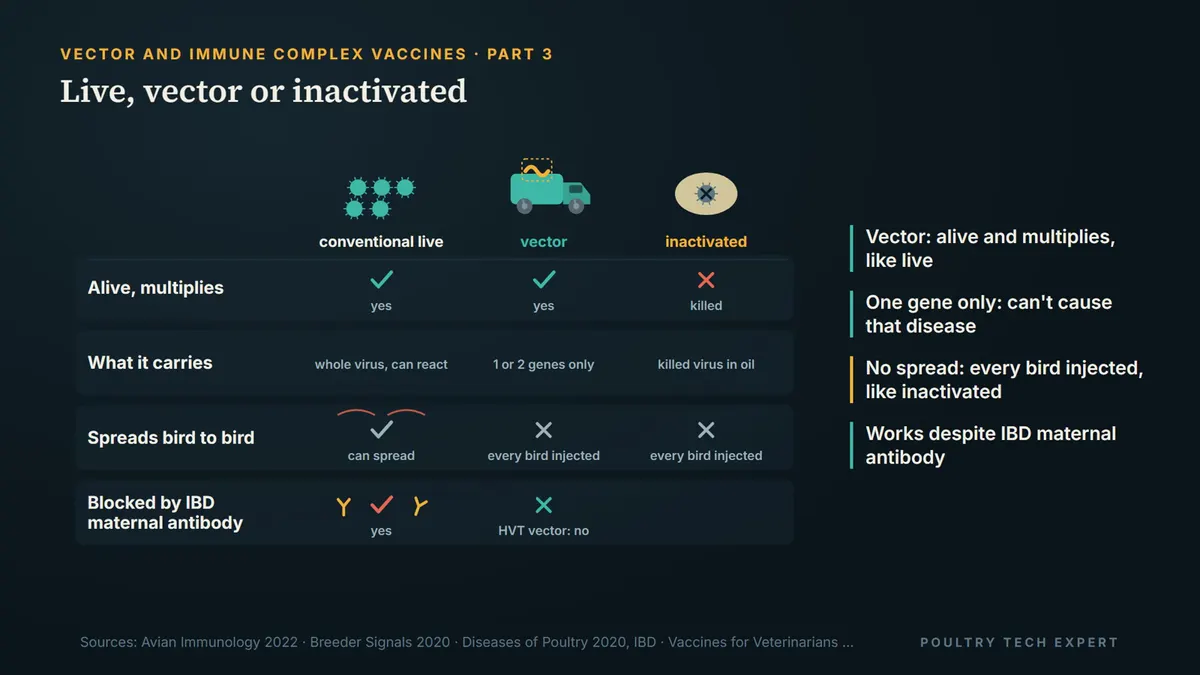
A vector is a live vaccine that works like an injection: one bird, one dose, no spread.
The rules of vectors
Vectors come with rules, and they matter on the farm.
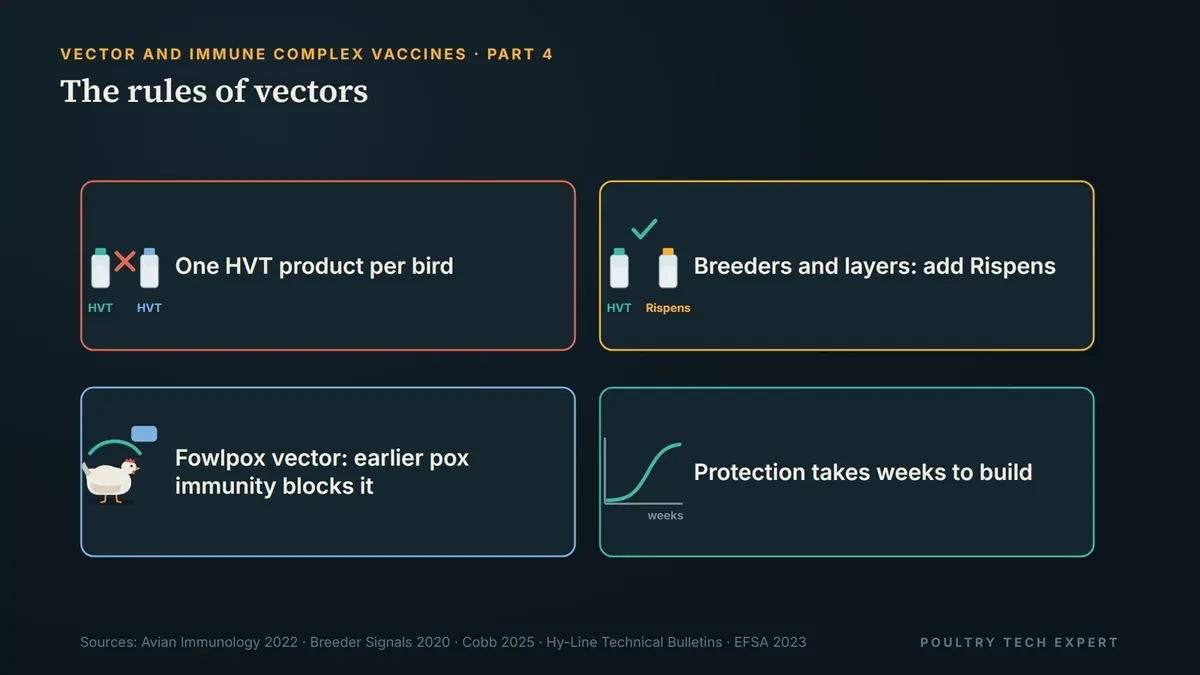
- One HVT product per bird. Two different HVT vector vaccines in the same chick interfere with each other, and protection drops for one or both.12 The same goes for a conventional HVT Marek's vaccine next to an HVT vector.67 If you want two diseases from HVT, they have to come in one product with two genes.1
- Breeders and layers: add Rispens. For long-lived birds like breeders and layers, guides add a second Marek's vaccine, Rispens, to the HVT vector, for better Marek's protection.67 Rispens isn't an HVT, so it doesn't break the first rule.
- Earlier pox immunity blocks a fowlpox vector. A fowlpox vector doesn't protect reliably in a bird that's already immune to fowlpox.1
- Protection takes time to build. In avian influenza studies with HVT vectors, antibody showed in most birds only from about 4 weeks after vaccination.9 For IBD, how fast protection starts depends on the product, and your vet and the supplier will know it.
A vector vaccine is a long-term investment, not a quick fix.
Immune complex vaccines
Vectors aren't the only way past maternal antibodies. For IBD, there's a second one, the immune complex vaccine.
First, the problem it solves. Give a chick with high IBD maternal antibody a conventional live IBD vaccine in the water, and the antibody neutralizes it.1 So you wait for it to fall, but the right day depends on its level, the vaccine and the challenge. Too early, and the vaccine is neutralized. Too late, and on a farm where the cleanout didn't remove the virus, the field virus can get there first.3
The immune complex vaccine is a live IBD vaccine of the intermediate type, mixed with antibodies against IBD, so the virus is coated in antibody.41 It's injected in the egg, or under the skin at day old.51
The coated virus is held in the chick's immune organs, and as the maternal antibody fades, it's released and immunizes the chick.12 The WOAH manual expects that at about 7 to 14 days of age, but the exact day follows each chick's own maternal antibody.52
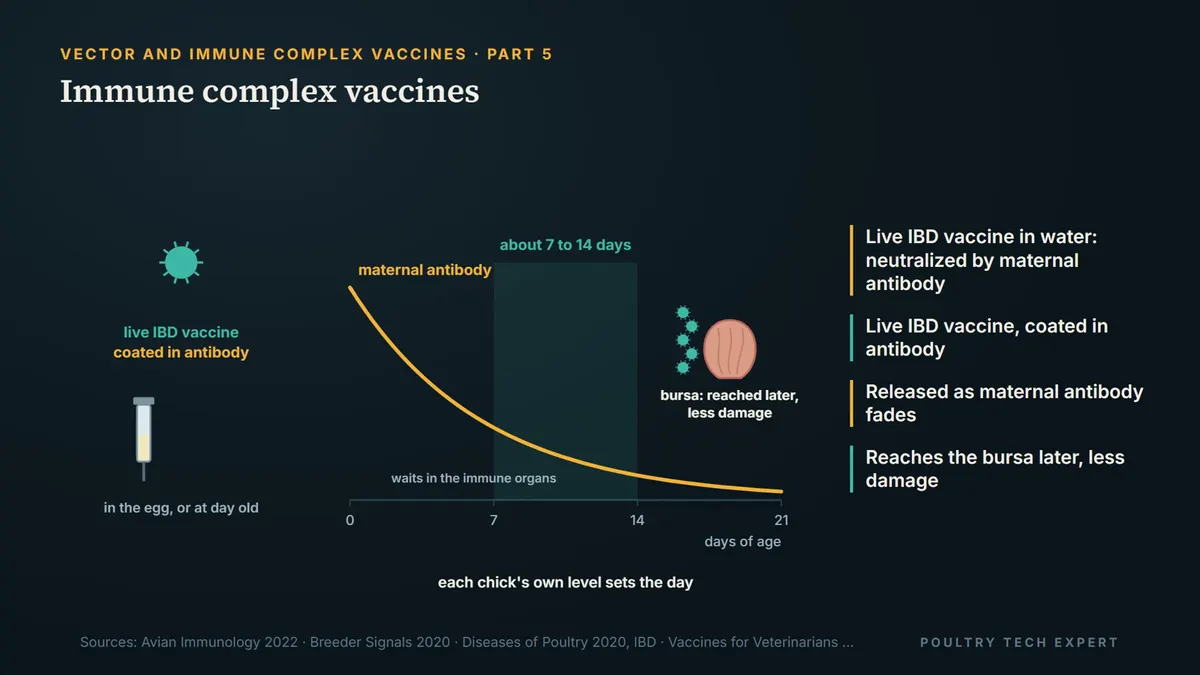
In studies, the coated virus reached the bursa about five days later than the same virus given alone, and it caused much less damage to the bursa and the spleen.4 But it's still a live IBD vaccine that does its work in the bursa. And not every product is available everywhere: in the United States, for example, the immune complex vaccine hasn't been.4
An immune complex vaccine is a timed release, and the chick's own maternal antibody sets the clock.
On the broiler farm
So what changes for a broiler manager?
Your vaccination program starts at the hatchery, so your records should too.
In the breeder program
For breeders, vectors fit into the program described in the article on live and inactivated vaccines.
HVT stays in the bird for life, which is why vectors are especially interesting in breeders.2 How long the protection against the carried disease lasts depends on the product, so that's a question for your vet and the supplier.
But the hen still needs her inactivated boosters at the end of rear. They're what give her chicks high maternal antibody for their first weeks.2 A vector at the hatchery doesn't replace them.8
And all of it depends on the hatchery. Most HVT vaccines are live viruses inside cells, kept frozen in liquid nitrogen. They have to be thawed and mixed carefully, and diluted quickly.612 For Marek's vaccines, poor handling, thawing or dilution is the major reason for a poor response.12 When you buy breeder chicks, hatchery vaccination quality is part of what you buy.
The vector protects the hen. Her inactivated boosters protect her chicks.
So, in short: a vector is a live carrier with one piece of a disease, injected into every bird, with one HVT product per bird. An immune complex holds a live IBD vaccine until the maternal antibody fades. Both get past maternal antibodies, but neither replaces a clean house or the breeder's boosters.
Know something better, or do it differently on your farms? Tell me in the comments under the video on YouTube.