
Almost every flock carries Marek's virus.1 Take parent stock chicks vaccinated in the hatchery: most of the time, that's enough.
But now and then, a vaccinated flock breaks. When it does, it's rarely bad luck, and it's rarely the vaccine itself. It's how the vaccine was handled, how this virus lives in the house, and how we ran the first weeks.71
This is mostly a breeder story. Broilers usually go to slaughter before tumors have time to grow, so in broilers, Marek's shows up mainly as condemnations at the processing plant.16 What follows is about the first weeks of a flock, and what they mean for how you run the hatchery, the house and the site.
The player loads from YouTube (privacy-enhanced mode) only when you press play. Watch it on YouTube.
It lives in the dust
First, where the virus actually comes from. The feather follicle is where the virus becomes fully infectious, and it comes off the bird with the dander.1 In house dust, it stays infectious for at least several months at room temperature, and for years in the cold.1
Birds start shedding about two weeks after infection, and they keep shedding for the rest of their lives.1 There's no transmission through the egg.1 So the chick picks it up on the farm, after placement: mostly from dust the last flock left behind, or from dust that people and equipment carry in from older flocks.1
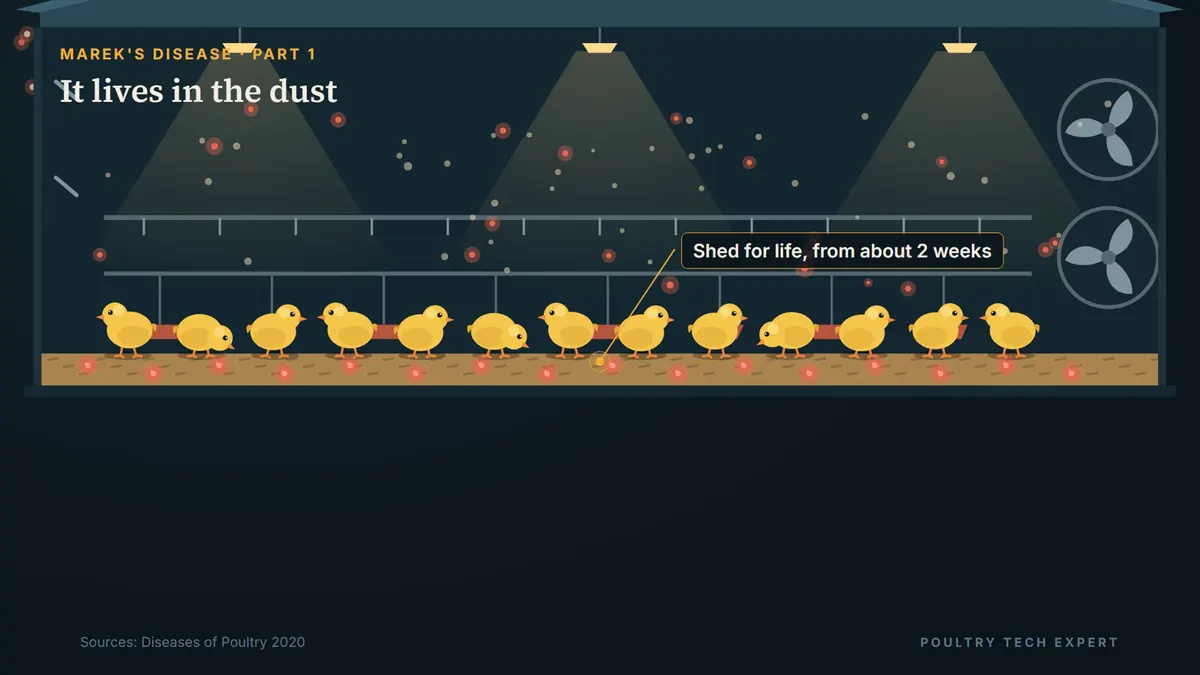
Whatever dust the last flock leaves behind is the first thing the next flock breathes.
Damage before any tumor
Most of us think of Marek's as tumors and paralysis. But in a series on immunosuppressive diseases, the more important side is what it does to the immune system.
In chicks that aren't protected yet, the virus destroys lymphocytes in the bursa and the thymus in the first two weeks after infection, and both organs can shrink badly.13 That weakens their response to other vaccines and other infections.1
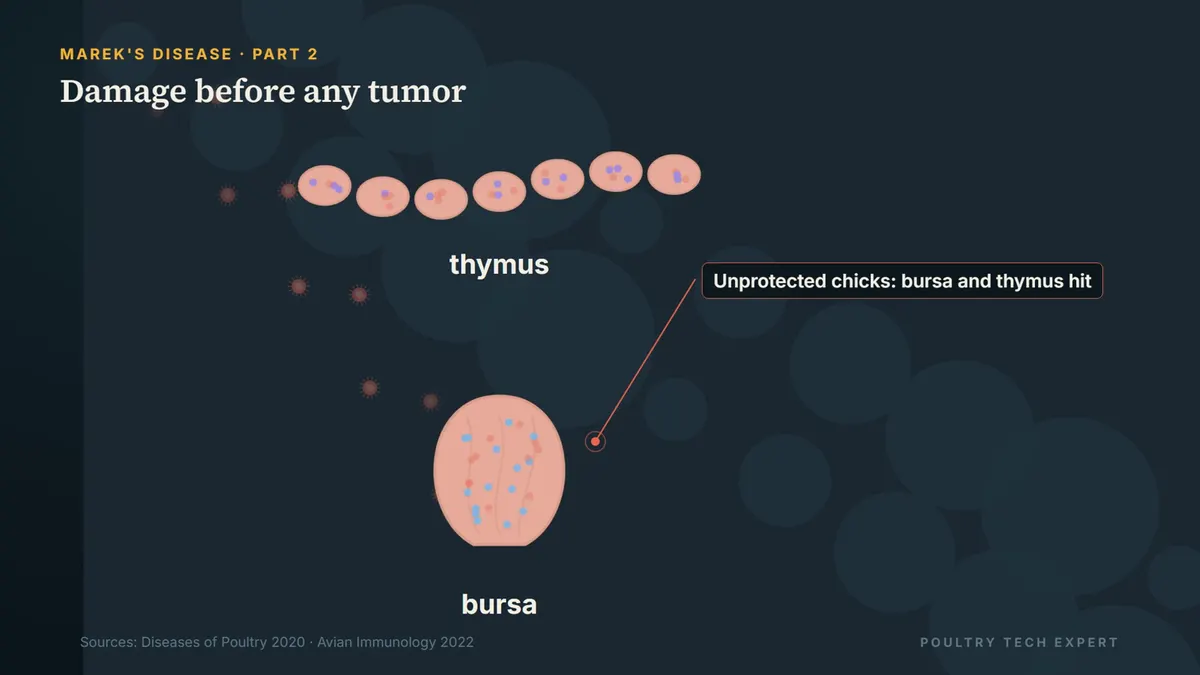
On top of that, the most virulent strains add a second, later hit to the immune system. There's no shrunken bursa, no tumors, nothing obvious at post-mortem, and today's vaccines don't stop it.1
So Marek's can weaken a flock long before you see a single paralyzed bird.
It protects the bird, not the house
So what does the vaccine actually do? Marek's vaccines are unusually effective. Under commercial conditions, they often give more than 90 percent protection against the disease.1
But they don't all hold up equally. HVT alone can be overwhelmed by an early, highly virulent challenge, while Rispens holds up better.1
And none of them stop infection or shedding.2 Vaccinated birds still inhale field virus with the dust, and they shed it too.4
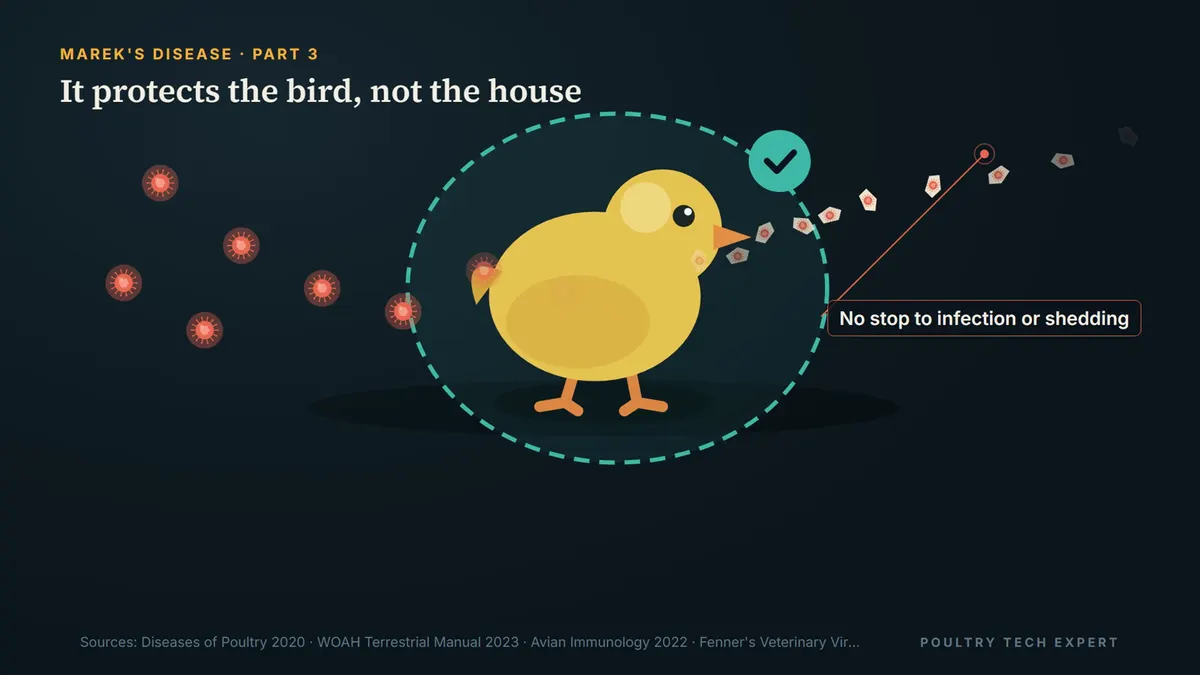
Over the decades, field strains have moved from virulent to very virulent, and then to very virulent plus.3 Vaccination has almost certainly contributed to that shift, because vaccinated birds can still carry and shed those strains.7 That's no reason to vaccinate less. It's why the dose and the house matter more than they used to.
The vaccine protects the bird. It doesn't protect the house.
A race against the clock
Now, the timing. After vaccination, the chick needs at least seven to ten days to build solid immunity.18 With in ovo vaccination, part of that is already behind the chick when it hatches. With day-old vaccination, all of it falls on the farm.
Don't count on maternal antibodies to close that gap. They can soften the very early infection, but they don't give reliable protection, and they can blunt the vaccine, especially cell-free HVT.1
Meanwhile, field exposure usually starts very soon after placement.1 A chick that lands in a heavily contaminated house can be infected before its immunity is ready.6 That's why early exposure is seen as perhaps the most important single cause of vaccine failures.12
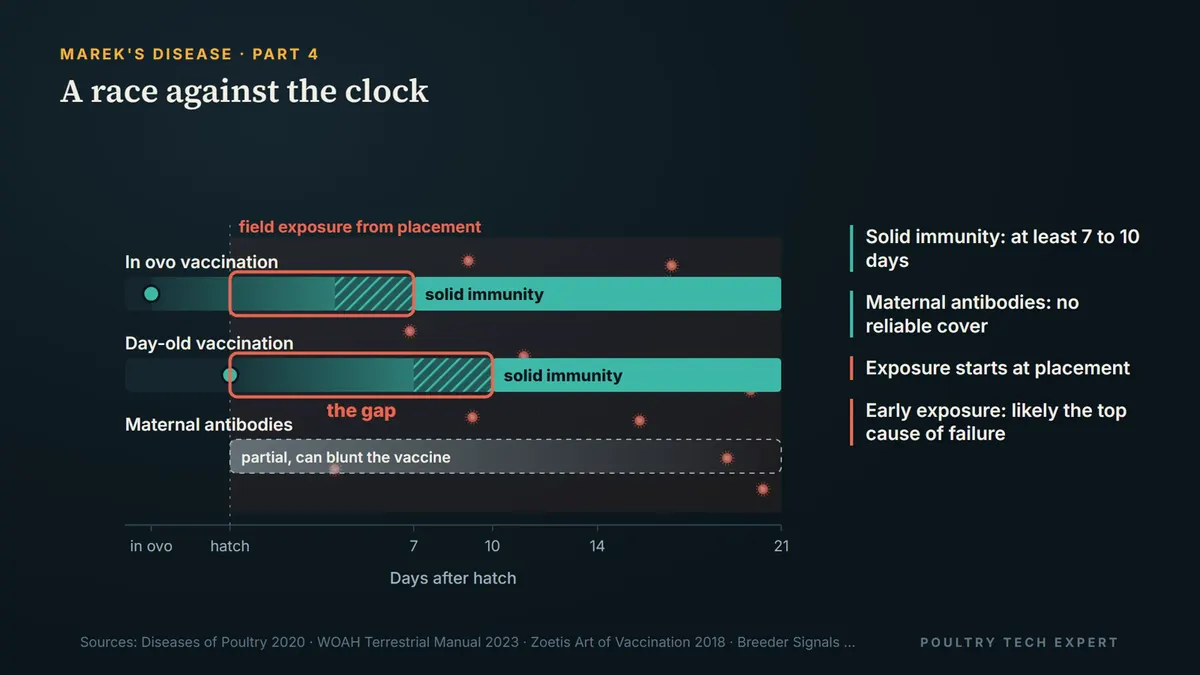
The less old dust there is at placement, the more time the vaccine gets.
The hatchery
That puts a lot on the hatchery. The vaccine goes in ovo at transfer, around day 18, or by injection at hatch.12 In ovo gives better protection against early challenge than day-old vaccination, as long as the vaccine reaches the amnion or the embryo.1
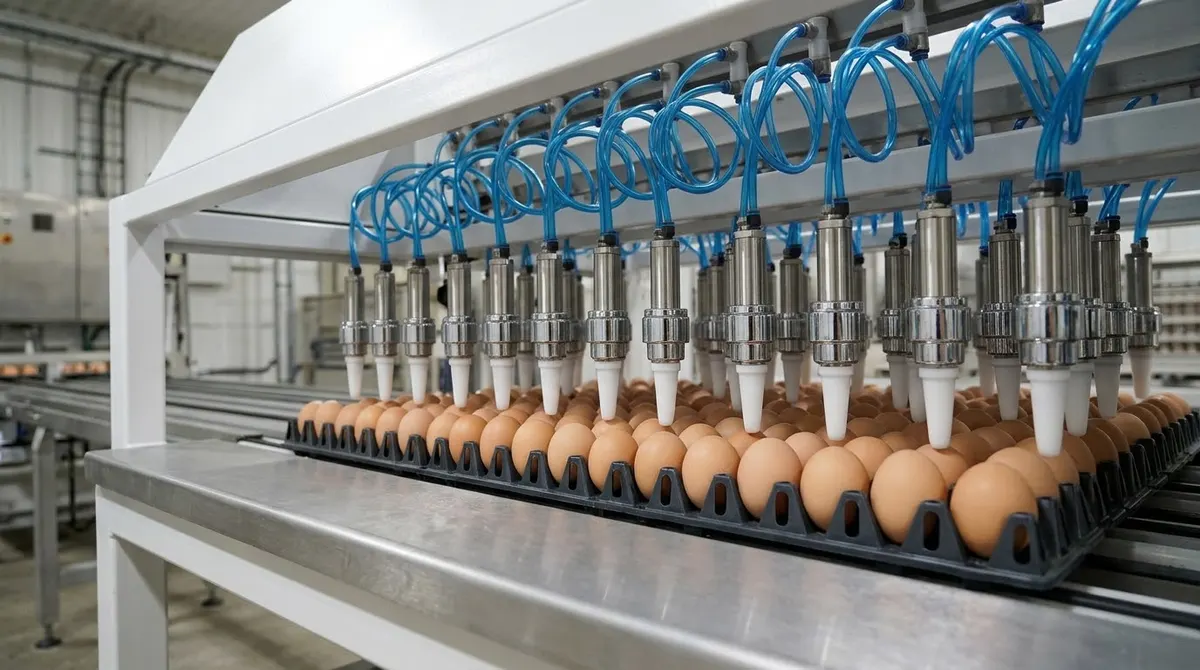
Most Marek's vaccines are cell associated and stored in liquid nitrogen.2 The thaw has to be fast, about a minute and a half in a warm water bath, and then straight into the diluent.710 From then on, the clock is running. Use it within the time on the label, typically one to two hours.710
And watch the dose. Breeder vaccine should never be diluted.6 Where broiler doses are cut, that's off label, and it can end in outbreaks.61 Against today's very virulent strains, it takes more vaccine virus to protect the chick, not less.1
Which strains go in, whether there's a second dose, and how an HVT vector vaccine for Gumboro or Newcastle fits in are decisions for your vet, based on your local challenge.61
So now and then, stand next to the vaccinator and watch: how long the thaw takes, how long since the bag was mixed, and where the in ovo dose lands. An underdosed chick looks exactly like a protected one.
The house and the site
On the farm, the levers are dust and age. Wherever you can, run single-age sites, all in, all out. Vaccination and cleaning both work better there.95
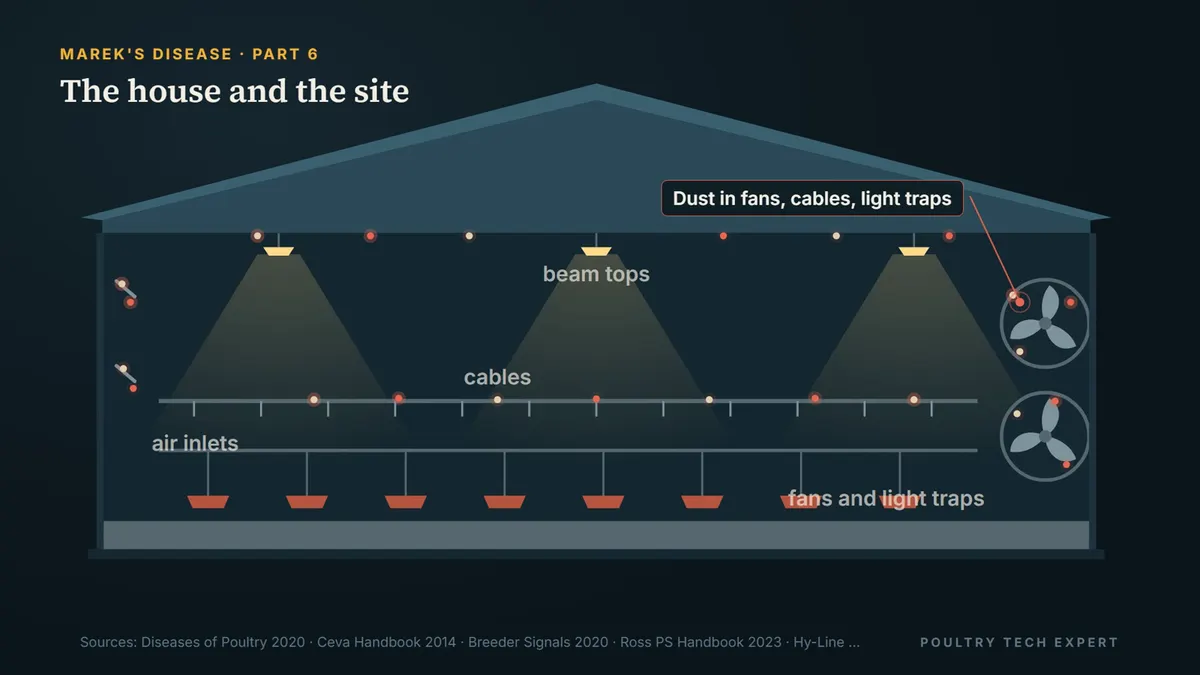
In breeder rearing, the old litter always goes out. The real gap is the dust that cleaning misses. Specks of dust and feathers stay inside the fans, between the cables, in the light traps, on the tops of beams and around the air inlets.911 And that dust stays infectious for months.1
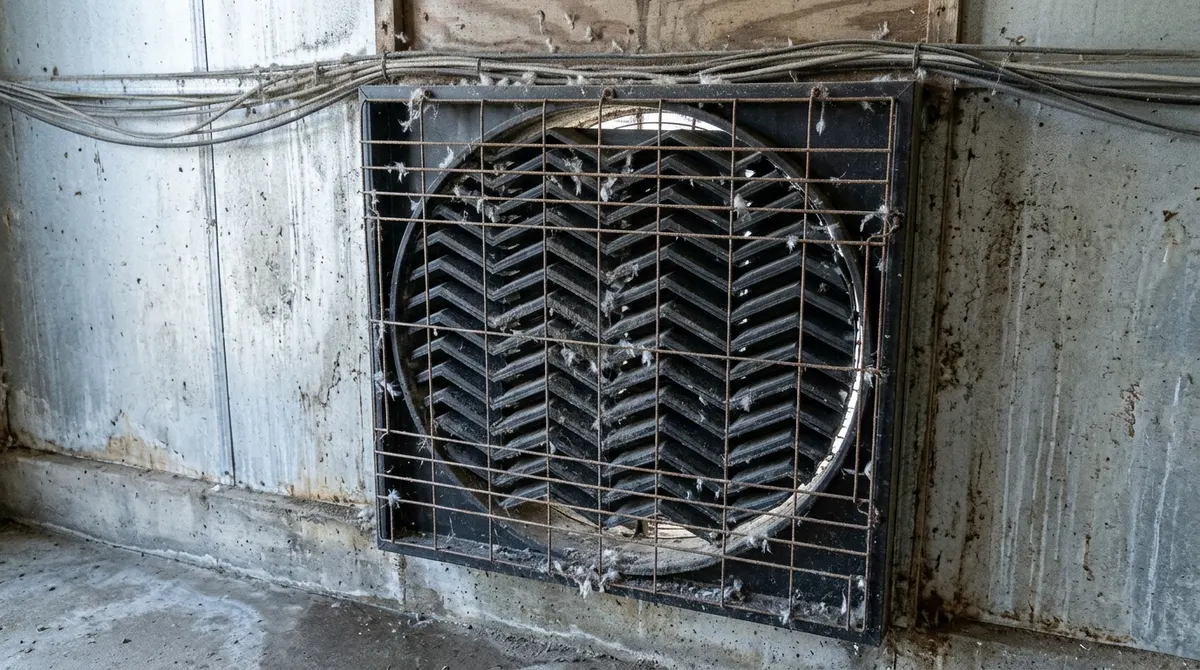
So clean from the top down, and brush that dust onto the old litter before the litter goes out.9 Where it's hard to reach, use scaffolding and a portable light.9 Better hygiene has often been key to ending excessive Marek's losses in vaccinated flocks.1
On multi-age sites, keep the chicks well away from older birds, and give them the most protection in the first month.58
An empty house full of old dust isn't a clean house.
Why breeders break late
For breeders, there's one more twist. Chicks that aren't well protected and get infected in their first six to eight weeks can show disease from about 15 weeks of age.8
Cases tend to climb as the flock comes into lay, and in broiler breeders, serious cases can start well after that.78
Coming into lay is a stress, and stress can break down vaccine protection that was holding until then.1 Other immunosuppressive infections, such as Gumboro and chicken anemia virus, can also interfere with the immunity the Marek's vaccine is trying to build.1 Both have their own parts later in this series.
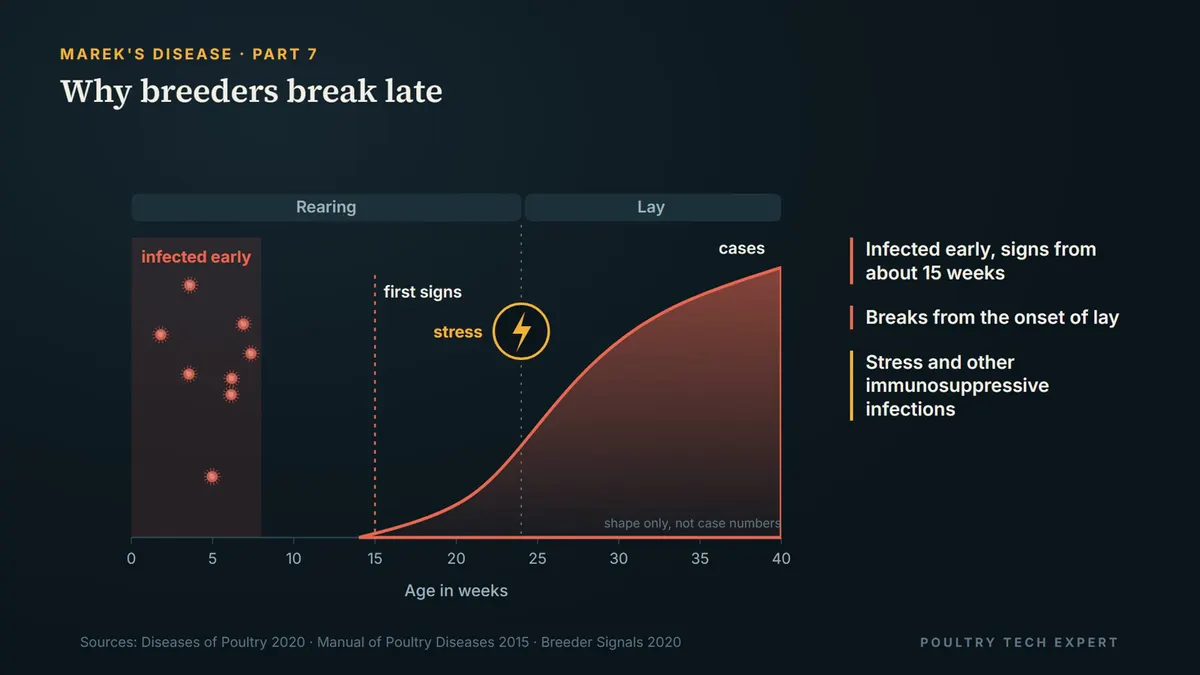
A Marek's break in lay was usually set up in the first weeks of rearing.
Confirmation belongs to the lab
Since the virus is almost everywhere, confirmation has to show the disease, the tumor, and not just the infection.12 Lymphoid leukosis and reticuloendotheliosis can look similar, and the lab has to rule them out.2
And when a vaccinated flock breaks, the usual checkpoints are the hatchery's vaccination technique, the vaccine batch, whether the vaccine actually took in the chicks, early exposure, and co-infection with other immunosuppressive viruses.1
In short
Marek's vaccines protect the bird, not the house. They need a full dose, a clean house, and as much time as you can give them before the chicks meet the virus.
Know something better, or do it differently on your farms? Tell me in the comments under the video on YouTube.